
Inside Our Manufacturing Process: How M Metal Tubes India Ensures Zero-Defect Quality
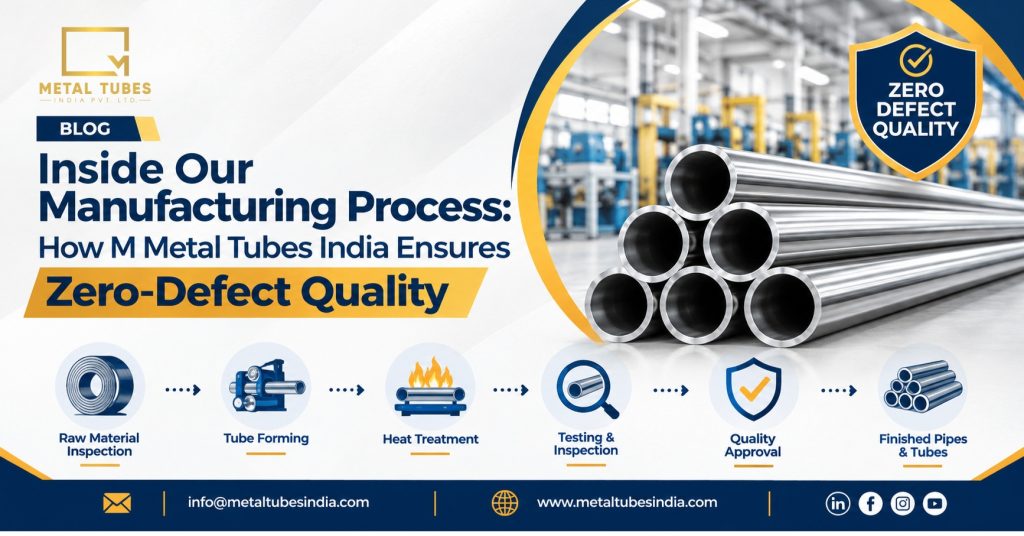
At M Metal Tubes India, our manufacturing process zero-defect quality standard shapes everything we do. First, we select the right raw material. Next, we form, treat, and test every tube with precision. As a result, our customers receive tubes they can rely on, batch after batch. In this blog, we take you inside our production floor. You’ll see exactly how we manufacture stainless steel, carbon steel, and alloy steel tubes — and why industries across oil & gas, power generation, and petrochemicals trust us with their most critical projects. Why Zero-Defect Quality Matters in Steel Tube Manufacturing A single defective tube can compromise an entire pipeline, boiler, or heat exchanger system. Therefore, our customers cannot afford to take chances with quality. For this reason, we don’t treat quality control as a final checkpoint. Instead, we build it into every stage of production. Many manufacturers call this approach “quality by design,” and it forms the foundation of our complete product range at M Metal Tubes India. Step 1: Raw Material Selection and Testing Every tube starts with the right raw material. First, our team sources billets and coils only from approved and certified suppliers. Before any material enters production, we run it through: Chemical composition testing to confirm the correct alloy grade Mechanical property verification for strength and ductility Surface inspection to rule out cracks, pits, or inclusions Consequently, if a batch doesn’t meet our internal benchmarks, we reject it immediately. This first checkpoint alone prevents a large share of potential defects before production even begins. Step 2: Precision Tube Forming Once the raw material clears inspection, it moves into forming. Depending on the specification, we use either: Seamless tube manufacturing, where we pierce and draw solid billets into hollow tubes without a weld seam Welded (ERW) tube manufacturing, where we roll and fuse steel strips using controlled high-frequency welding Our machines maintain tight tolerances on outer diameter (OD), wall thickness, and length. Because even a small deviation here can affect performance downstream, experienced operators monitor this stage closely during every shift. Step 3: Heat Treatment for Strength and Durability After forming, tubes go through heat treatment — annealing, normalizing, or quenching and tempering, depending on the grade and end application. Heat treatment achieves two important goals. First, it relieves internal stresses created during forming. Second, it enhances mechanical strength, corrosion resistance, and durability. This step becomes critical for tubes operating in high-pressure or high-temperature environments, such as our boiler and heat exchanger tubes. Step 4: Dimensional and Surface Finishing Next, every tube passes through finishing operations. This stage includes: Straightening to correct any bends from forming or heat treatment Cutting to exact length as per customer specification Surface finishing, including pickling, polishing, or bright annealing, depending on the application At this point, our quality team re-checks dimensions against the original customer specification sheet. As a result, nothing moves forward without matching the exact requirement. Step 5: Rigorous Testing Before Dispatch This is where our manufacturing process zero-defect quality commitment truly comes to life. Before we approve any tube for dispatch, we put it through a series of rigorous quality tests to check strength, pressure resistance, and any hidden surface or internal flaws. Only tubes that pass every test move to the next stage. Meanwhile, we set aside or reject anything that doesn’t meet our standard — no exceptions. Step 6: Final Inspection and Documentation Before dispatch, we run each batch of tested tubes through a final visual and dimensional inspection. In addition, we prepare complete test certificates and material traceability documentation, so customers know exactly what they’re receiving — and can trace it back to the original raw material batch if needed. This transparency explains why EPC contractors, fabricators, and industrial buyers continue to choose our seamless and welded tube solutions for repeat orders. Manufacturing Process Zero-Defect Quality: What Makes It Different Here’s what sets our process apart: Multi-stage inspection, not just a final check Experienced engineers overseeing every production stage Fully tested tubes with traceable documentation from raw material to finished product Consistent tolerances across every batch, not just samples Overall, zero-defect quality isn’t a slogan for us. Instead, it’s a system — built stage by stage, checked at every point, and backed by documentation you can trust. Frequently Asked Questions What types of steel tubes does M Metal Tubes India manufacture? We manufacture seamless and welded (ERW) tubes in stainless steel, carbon steel, and alloy steel grades. Consequently, our tubes serve industries like oil & gas, power, petrochemicals, and infrastructure. How does M Metal Tubes India ensure quality at every stage? We run quality checks at every stage of production — raw material testing, forming, heat treatment, finishing, and final testing — rather than only at the end. Are all tubes tested before dispatch? Yes. We test every tube rigorously and inspect it fully before dispatch. Therefore, only fully tested, defect-free tubes reach our customers. Conclusion From raw material to final dispatch, we design every stage of our production around one commitment: delivering manufacturing process zero-defect quality to every customer, every time. This is the standard M Metal Tubes India holds itself to — and it explains why our tubes perform reliably in the industries that can least afford failure. Looking for steel tubes manufactured to the highest quality standards? Contact M Metal Tubes India today to discuss your requirement.
Types of Male Connectors: A Complete Guide to Instrumentation Fittings
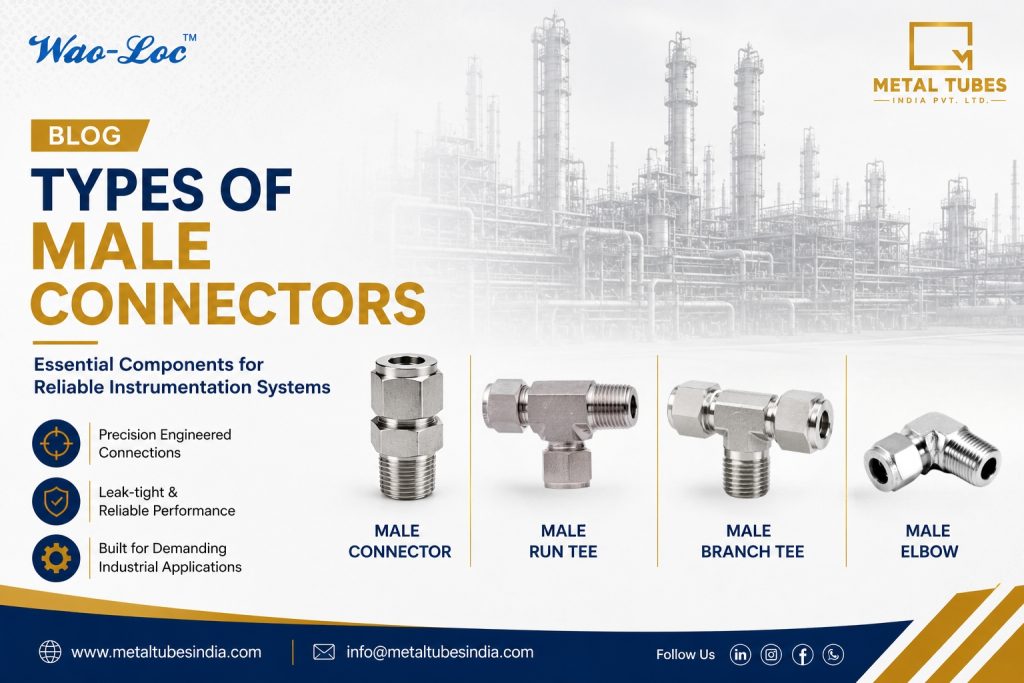
If you’re comparing the different types of male connectors for your next project, you’re in the right place. Choosing the correct connector matters it’s one of the most important decisions an engineer makes when building a leak-proof instrumentation system. So, where do you start? Male connectors form the backbone of any instrumentation tube fittings setup. They connect tubing to valves, gauges, and manifolds. And they do it with precision. At M Metal Tubes India Pvt Ltd, we manufacture a full range of stainless steel male connectors. We build them for oil & gas, petrochemical, power, pharmaceutical, and process industries. In this guide, we explain all six types of male connectors, their applications, and how to pick the right one. Whether you need instrumentation fittings male connectors, tube-to-thread adapters, or specialized bulkhead and tee connectors, this blog has you covered. What Is a Male Connector in Instrumentation Fittings? A male connector joins a tube to a female-threaded port on a valve or instrument. One end grips the tubing through a compression fitting. The other end has male threads NPT, BSP, or BSPP that screw directly into equipment. These threads follow standard pipe thread specifications set by bodies like ASME, which define dimensions and tolerances for interchangeable fittings. Male connectors matter because they: Create a leak-tight seal, even under high pressure and vibration Allow quick assembly and disassembly for maintenance Remove the need for welding in critical instrumentation lines Resist corrosion when made from stainless steel Now, let’s look at the six main types of male connectors and where you’ll use each one. The 6 Main Types of Male Connectors in Instrumentation Fittings Below, we break down each of the six types of male connectors you’ll find in a typical instrumentation fittings catalog. 1. Male Connector (Tube OD x Male NPT) Engineers use the Male Connector (Tube OD x Male NPT) more than any other fitting in instrumentation tube fittings. One end connects to the tube’s outer diameter through a compression ferrule. The other end carries National Pipe Thread (NPT), which screws into instruments, valves, or manifolds. Key applications: Connecting instrumentation tubing to pressure gauges Joining tubing to valve bodies in process skids Serving oil & gas and chemical plants worldwide We offer this fitting in multiple tube OD sizes — 1/4″, 3/8″, 1/2″, and more. We also match it to various NPT thread sizes so it fits international piping standards. 2. Male Connector (BSP/BSPP) Some regions follow British Standard Pipe threads instead of NPT. That’s where the Male Connector (BSP/BSPP) comes in. BSP (tapered) and BSPP (parallel) threads dominate European and Middle Eastern instrumentation systems. Key applications: Export projects that require BSP-standard fittings Instrumentation systems built to DIN/ISO standards Setups where an O-ring seal (BSPP) gives a more reliable connection Not sure which thread type you need? Your plant’s regional piping code decides it. Our engineering team can help you choose correctly. 3. Male Elbow 90 Degree Space is often tight in a control panel. That’s exactly where the Male Elbow 90 Degree connector helps. It lets tubing change direction by 90 degrees while connecting to a threaded port — no extra bending required. Key applications: Panel-mounted instrumentation in tight spaces Reducing tube bends, which lowers stress on the tubing Connecting tubing to instruments mounted at right angles As a result, using a male elbow 90 degree connector saves installation time. It also improves the overall strength of the tube run. 4. Male Bulkhead Connector Need to pass tubing through a wall or panel? Use a Male Bulkhead Connector. It maintains a leak-proof seal on both sides, thanks to a locknut and a threaded body that passes through a drilled hole. Key applications: Panel mounting in control cabinets and instrument enclosures Passing tubing through pressure vessel walls Vibration-resistant connections in demanding environments In fact, this is one of the most requested instrumentation fittings male connector types among OEMs who build compact instrumentation panels. 5. Male Run Tee The Male Run Tee connector has three ports. Two tube-end ports sit in a straight line the “run.” The third port carries a male thread for a branch connection. This design lets a straight tube run continue without interruption, while still offering a threaded point for a gauge or transmitter. Key applications: Installing pressure gauges mid-line, without breaking the tube run Adding branch connections for instrumentation sensors Cutting down the number of fittings in complex tube layouts 6. Male Branch Tee The Male Branch Tee looks similar to the run tee. However, the male-threaded port sits differently. It typically creates a perpendicular connection, while the tube run stays on the same centerline. Use it when you need the threaded port to sit off to the side, not in line with the main run. Key applications: Multi-point instrumentation sampling systems Adding a threaded takeoff point in compact panel layouts Creating a perpendicular branch off a continuous tube line Male Run Tee vs Male Branch Tee What’s the Difference? Port orientation makes the difference. A run tee keeps the branch port in line with the flow path. This makes mid-line instrument installation easy. A branch tee, on the other hand, offsets the threaded port. So, it gives installers more flexibility in tight panel layouts. Why Choose Stainless Steel Male Connectors? We manufacture most instrumentation fittings including all six connector types above in stainless steel (SS 316/316L, SS 304). Why? Because instrumentation systems face tough operating conditions. Stainless steel male connectors deliver: Corrosion resistance in chemical, marine, and offshore environments High pressure and temperature tolerance for critical process lines Long service life with minimal maintenance Compliance with international instrumentation standards So, if you’re sourcing instrumentation fittings for a critical application, stainless steel is almost always the smart choice. How to Choose the Right Type Among the Different Male Connectors Before you order instrumentation fittings male connectors, check these five points: Tube size and thread size — Match the tube OD and thread type (NPT, BSP, or BSPP) to your existing system. Application layout — Choose elbows
Instrumentation Fittings – The Backbone of Industrial Precision
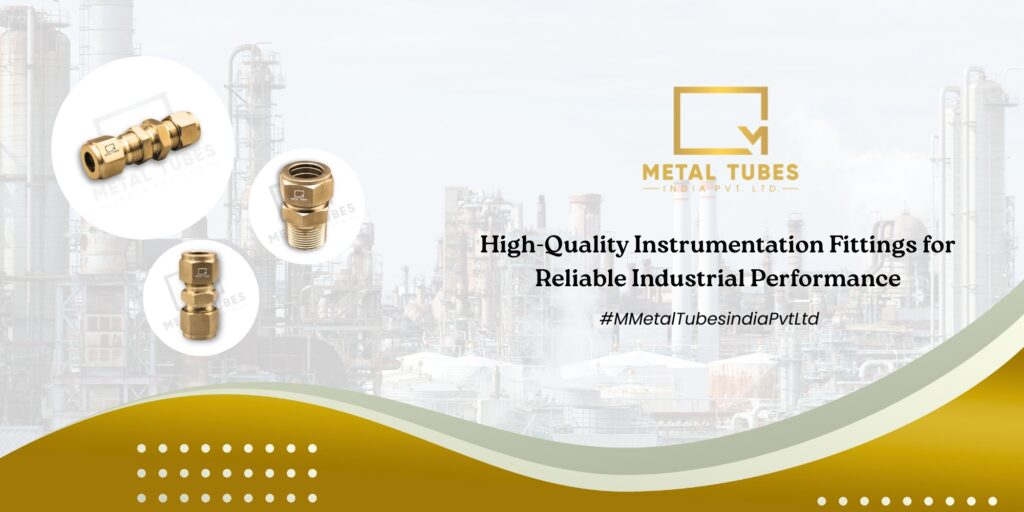
Instrumentation Fittings – The Backbone of Industrial Precision Instrumentation Fittings – The Backbone of Industrial Precision In every industrial environment, precision is critical. Even the smallest connection plays a major role in maintaining safety, accuracy, and smooth operations. One such essential component is instrumentation fittings—the backbone of reliable and efficient industrial systems. At M Metal Tubes India Pvt Ltd, we believe that every connection matters. As one of India’s trusted manufacturers and suppliers of instrumentation fittings, we deliver products engineered to withstand pressure, resist corrosion, and provide leak-free performance every time. What Are Instrumentation Fittings? Instrumentation fittings are precision-engineered connectors used to join tubes and pipes in instrumentation and control systems. They regulate and direct the flow of liquids or gases while maintaining system integrity and accuracy. These fittings work alongside critical instruments such as pressure gauges, valves, flow meters, and transmitters, making them indispensable in modern process control applications. Whether used in power plants, refineries, or marine environments, they are designed to perform reliably—even under extreme conditions. Our Range of Instrumentation Fittings At M Metal Tubes India Pvt Ltd, we manufacture a comprehensive range of instrumentation fittings to meet diverse industrial requirements. Each product is crafted with a strong focus on precision, durability, and quality. Our Product Range Includes: Compression Tube FittingsDesigned for secure, leak-proof connections in high-pressure applications. Ferrule FittingsProvide excellent tube grip and vibration resistance for long-term reliability. Flare FittingsIdeal for heavy-duty systems requiring strong mechanical sealing. Pipe FittingsManufactured for dimensional accuracy, strength, and easy installation. Male & Female ConnectorsVersatile fittings designed for extended service life across applications. All our fittings undergo strict quality checks and comply with international standards such as ASTM, DIN, and ISO. Industries We Serve Our instrumentation fittings are widely used across multiple industries, including: Oil & Gas Refineries Power Generation Plants Petrochemical & Chemical Processing Units Marine & Offshore Applications Instrumentation & Control Panels Energy and Process Industries Wherever precision, safety, and reliability are essential, M Metal Tubes India Pvt Ltd delivers dependable solutions. Why Choose M Metal Tubes India Pvt Ltd? Choosing the right instrumentation fittings is about more than just components—it’s about choosing a trusted partner. What Sets Us Apart: ✅ Superior Quality – Manufactured using premium-grade stainless steel and brass for corrosion resistance and long life✅ Precision Engineering – CNC-machined fittings with accurate dimensions and flawless finishes✅ Global Compliance – Products conform to ASTM, BS, DIN, and ISO standards✅ Timely Delivery – Efficient supply chain with ready stock for quick dispatch✅ Customer-First Approach – Built on trust, transparency, and long-term partnerships We are also proud of our in-house brand, Waoloc Instrumentation, offering high-performance valves, manifold valves, and needle valves for critical industrial applications. Our Commitment to Quality Quality is at the core of everything we do. From raw material inspection to final testing, our instrumentation fittings undergo rigorous checks for pressure resistance, dimensional accuracy, and performance. Each product is carefully packed to ensure it reaches you in perfect condition—ready to perform from day one. Sustainability & Continuous Innovation At M Metal Tubes India Pvt Ltd, we are committed to sustainable manufacturing practices. We continuously work to reduce waste, optimize energy usage, and improve product efficiency. Through ongoing research and development, we innovate smarter, stronger, and more environmentally responsible instrumentation solutions. Conclusion Instrumentation fittings may be small components, but their impact on industrial systems is significant. At M Metal Tubes India Pvt Ltd, we take pride in manufacturing fittings that represent accuracy, reliability, and long-lasting performance. Every product we deliver reflects our dedication to engineering excellence and customer satisfaction. Get in Touch With Us Looking for high-quality, reliable instrumentation fittings for your industrial needs? 📞 Contact us today!Let’s build stronger, safer, and more efficient connections together. Email: info@metaltubesindia.comPhone: +91 9323076453Website: www.metaltubesindia.com More Blogs Understanding Flange Ratings – M Metal Tubes India Pvt Ltd What Is Flange Class? Complete Guide to Class 150, 300, 600 Ratings | M Metal Tubes India Pvt Ltd Manufacturing Process of Stainless Steel Pipes Step by Step | Industrial Guide How High-Quality Tubing Improves Process Reliability | Industrial Guide 2025