
Why High-Quality Instrumentation Fittings & Valves Are Essential for Industrial Systems
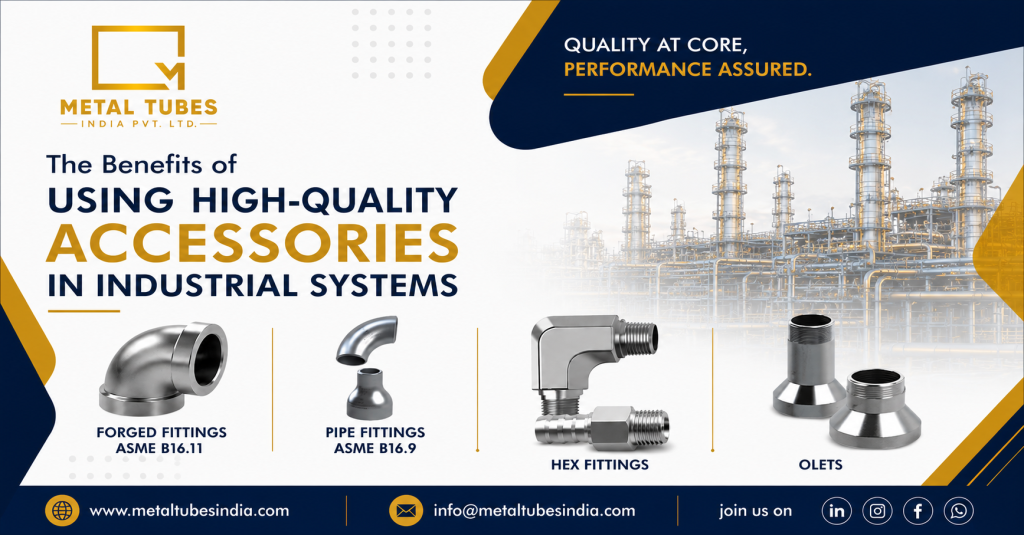
Industrial process systems demand precision, reliability, and safety. High Quality Instrumentation Fittings play a vital role in ensuring leak-proof connections, accurate flow control, and long-term operational efficiency. From oil & gas plants to pharmaceutical facilities, these small yet essential components help keep industrial systems running safely and efficiently. At M Metal Tubes India Pvt. Ltd., we manufacture precision-engineered instrumentation fittings, valves, stainless steel tubes, pipe fittings, manifolds, flanges, and accessories that meet the demanding requirements of modern industries. Our products are built to deliver reliable performance in high-pressure and corrosive environments. Why High Quality Instrumentation Fittings Are Important Instrumentation fittings connect critical components in industrial systems. They ensure the smooth flow of liquids, gases, and chemicals while maintaining pressure integrity. Using High Quality Instrumentation Fittings offers several advantages: Leak-proof connections Reliable performance Improved safety Longer service life Reduced maintenance costs Choosing premium fittings helps prevent system failures and costly downtime. Benefits of High Quality Instrumentation Fittings 1. Improved System Reliability Reliable fittings reduce the risk of leaks and pressure loss. High-quality materials and precision manufacturing ensure consistent performance, even under demanding operating conditions. 2. Better Safety Industrial systems often operate under high pressure and temperature. Quality instrumentation fittings help prevent leakage, protecting both personnel and equipment. 3. Lower Maintenance Costs Premium fittings last longer and require fewer replacements. This reduces maintenance expenses and minimizes unexpected shutdowns. 4. Excellent Corrosion Resistance Stainless steel instrumentation fittings provide excellent resistance to corrosion, making them suitable for chemical, pharmaceutical, and marine applications. 5. Higher Operational Efficiency Precision-engineered fittings ensure smooth flow and accurate pressure control, helping industrial systems operate more efficiently. Applications of High Quality Instrumentation Fittings High Quality Instrumentation Fittings are widely used across various industries, including: Oil & Gas Petrochemical Plants Chemical Processing Pharmaceutical Manufacturing Power Generation Water Treatment Plants Food & Beverage Industry Process Automation Systems These industries require dependable components that deliver consistent performance in challenging environments. Why Choose M Metal Tubes India Pvt. Ltd.? M Metal Tubes India Pvt. Ltd. is a trusted manufacturer and supplier of high-quality instrumentation products for industrial applications. Our product range includes: Instrumentation Tube Fittings Stainless Steel Tubes Needle Valves Ball Valves Non Return Valves (NRV) Pipe Fittings Manifold Valves Flanges Air Headers Condensate Pots Every product is manufactured using premium-grade materials and undergoes strict quality checks to ensure durability, precision, and reliable performance. Industries We Serve Our instrumentation products are trusted by customers across multiple industries, including: Refineries Petrochemical Plants Chemical Industries Pharmaceutical Companies Power Plants Water & Wastewater Treatment Marine & Offshore Engineering & EPC Projects We are committed to delivering products that meet the highest standards of quality and performance. Conclusion Choosing High Quality Instrumentation Fittings is an investment in the safety, efficiency, and reliability of your industrial operations. Premium fittings reduce maintenance costs, improve system performance, and ensure long-term durability. At M Metal Tubes India Pvt. Ltd., we provide precision-engineered instrumentation fittings, valves, tubes, and accessories designed to meet the needs of modern industries. Whether you operate in oil & gas, chemical processing, pharmaceuticals, or power generation, our products help keep your systems running smoothly and efficiently. Contact our team today to learn more about our complete range of instrumentation solutions.
SS304 vs SS316 Instrumentation Fittings: Complete Comparison Guide for Industrial Applications
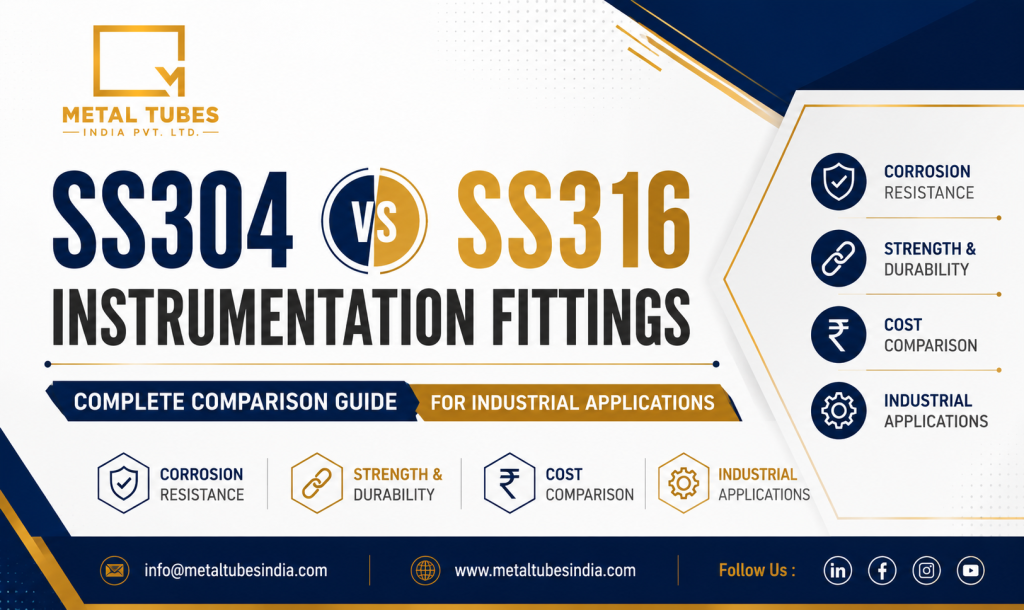
The SS304 vs SS316 Instrumentation Fittings comparison is one of the most important considerations when selecting components for industrial instrumentation systems. Both stainless steel grades offer excellent durability and reliability. However, they differ in corrosion resistance, chemical composition, cost, and applications. Understanding the differences between SS304 and SS316 instrumentation fittings can help engineers, procurement teams, and plant operators choose the right material for long-term performance. In this guide, we will compare SS304 vs SS316 instrumentation fittings in terms of corrosion resistance, strength, durability, temperature performance, cost, and industrial applications. Moreover, we will explain when to choose SS304 and when SS316 becomes the better investment. By the end of this article, you will have a clear understanding of which material best suits your operational requirements. What Are Instrumentation Fittings? Instrumentation fittings are precision-engineered components used to connect, control, and direct the flow of liquids and gases within instrumentation systems. These fittings play a critical role in maintaining leak-free performance, ensuring system reliability, and supporting safe operations. Common types of instrumentation fittings include: Tube Fittings Double Ferrule Fittings Compression Fittings Elbows Tees Unions Reducers Adapters As a result, these fittings are widely used in oil and gas, petrochemical, chemical processing, pharmaceutical, and power generation industries. Understanding Stainless Steel Grades Before comparing SS304 and SS316 instrumentation fittings, it is important to understand the role of stainless steel in industrial systems. Stainless steel contains chromium, which forms a protective oxide layer on the surface. Consequently, this layer helps prevent rust and corrosion. Furthermore, additional alloying elements can improve performance in challenging environments. The two most popular grades for instrumentation fittings are SS304 and SS316. Although they appear similar, their performance differs significantly under certain operating conditions. What Is SS304 Stainless Steel? SS304 is an austenitic stainless steel that contains approximately 18–20% chromium and 8–10.5% nickel. Because of its balanced properties and cost-effectiveness, it has become one of the most widely used stainless steel grades worldwide. Benefits of SS304 Instrumentation Fittings Excellent corrosion resistance in normal environments Good mechanical strength Easy fabrication and welding Cost-effective solution Widely available in global markets Therefore, SS304 instrumentation fittings are suitable for many general industrial applications. What Is SS316 Stainless Steel? SS316 is an upgraded stainless steel grade that contains molybdenum in addition to chromium and nickel. The presence of molybdenum significantly improves corrosion resistance, especially in chloride-rich and chemically aggressive environments. Benefits of SS316 Instrumentation Fittings Superior resistance to corrosion Better protection against chlorides Longer service life Excellent performance in marine applications Enhanced resistance to chemicals and acids Consequently, SS316 instrumentation fittings are often selected for demanding industrial environments. SS304 vs SS316 Instrumentation Fittings: Key Differences 1. Chemical Composition The primary difference between SS304 and SS316 instrumentation fittings is the addition of molybdenum in SS316. Property SS304 SS316 Chromium 18–20% 16–18% Nickel 8–10.5% 10–14% Molybdenum No 2–3% As a result, SS316 offers better protection against corrosion and pitting. 2. Corrosion Resistance Corrosion resistance is often the deciding factor when selecting instrumentation fittings. SS304 performs well in freshwater and general industrial environments. However, it may experience pitting corrosion when exposed to chlorides or saltwater. On the other hand, SS316 performs exceptionally well in coastal, marine, and chemical processing environments. Therefore, industries that face harsh conditions often prefer SS316. 3. Mechanical Strength Both materials provide excellent strength and durability. In most industrial applications, the difference in mechanical performance is minimal. Nevertheless, SS316 generally offers slightly better performance under aggressive operating conditions. 4. Temperature Performance Instrumentation systems frequently operate at elevated temperatures. While both grades perform well, SS316 offers improved resistance in high-temperature environments. Therefore, SS316 is often selected for applications involving extreme process conditions. 5. Cost Comparison Cost is another important factor when comparing SS304 vs SS316 instrumentation fittings. SS304 is more affordable because it contains lower levels of alloying elements. Consequently, it is commonly used in projects where budget is a major consideration. However, SS316 often delivers greater long-term value due to reduced maintenance costs and longer service life. Applications of SS304 Instrumentation Fittings SS304 instrumentation fittings are commonly used in: Food processing plants Water treatment facilities HVAC systems Pharmaceutical equipment General manufacturing industries Because these environments are relatively less corrosive, SS304 often provides sufficient performance. Applications of SS316 Instrumentation Fittings SS316 instrumentation fittings are commonly used in: Offshore oil and gas platforms Marine industries Petrochemical plants Chemical processing facilities Desalination plants Fertilizer industries Since these environments are highly corrosive, SS316 provides superior reliability and durability. How to Choose Between SS304 and SS316 Instrumentation Fittings Choose SS304 if: Your environment has low corrosion risk. Budget optimization is important. Freshwater applications are involved. General industrial performance is sufficient. Choose SS316 if: Chlorides are present. The installation is near coastal areas. Chemical exposure is significant. Maximum service life is required. Downtime must be minimized. Therefore, the final decision should be based on operating conditions rather than initial cost alone. Frequently Asked Questions Is SS316 better than SS304? SS316 offers better corrosion resistance. However, SS304 may be the better choice for standard industrial applications due to its lower cost. Why is SS316 more expensive? SS316 contains molybdenum and higher nickel content. Consequently, its production cost is higher than SS304. Can SS304 be used in marine environments? While SS304 can be used in some marine applications, SS316 is generally recommended because of its superior resistance to saltwater corrosion. Which stainless steel grade lasts longer? In corrosive environments, SS316 typically lasts longer and requires less maintenance. Conclusion When comparing SS304 vs SS316 instrumentation fittings, there is no universal winner. Instead, the best choice depends on your operating environment, process requirements, and budget. If you need a cost-effective solution for general industrial applications, SS304 instrumentation fittings are an excellent option. However, if your system operates in marine, chemical, offshore, or highly corrosive environments, SS316 instrumentation fittings provide greater protection, longer service life, and improved reliability. Ultimately, selecting the right material helps ensure leak-free performance, enhanced safety, and lower maintenance costs throughout the life of the instrumentation system.
What is a 3 Way Ball Valve? Working, Types & Uses Explained
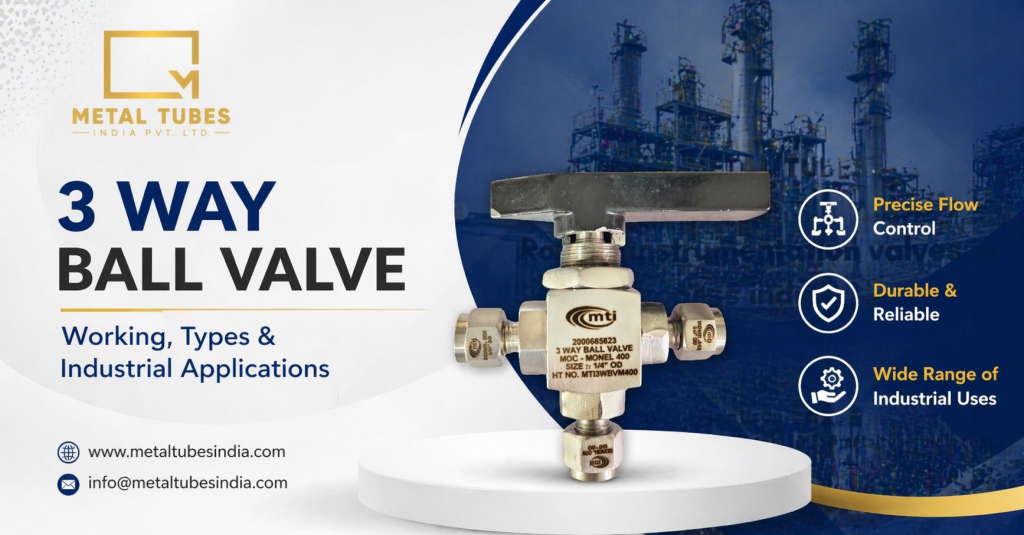
Introduction In industrial piping systems, controlling the direction and flow of fluids is essential for smooth and safe operations. While standard valves handle simple on/off control, many applications require more flexibility. This is where a 3 way ball valve becomes highly effective. Designed to manage multiple flow paths within a single unit, 3 way ball valves help reduce system complexity, improve efficiency, and minimize installation costs. They are widely used across industries such as oil & gas, chemical processing, power generation, and water treatment. In this guide, we explain what a 3 way ball valve is, how it works, its types, and its key industrial uses, so you can make an informed decision for your application. What is a 3 Way Ball Valve? A 3 way ball valve is a quarter-turn valve equipped with three ports, allowing fluid to flow in multiple directions. Unlike a standard 2-way valve, which only permits straight flow, this valve can divert, mix, or shut off flow depending on its design. The internal mechanism consists of a rotating ball with a specially designed bore. By turning the handle or actuator, the flow path changes, enabling different configurations within the same valve body. Working Principle of a 3 Way Ball Valve The working of a 3 way ball valve is based on a simple yet efficient mechanism. Inside the valve, a drilled ball rotates when the handle is turned 90 degrees. This rotation aligns the internal passage with different ports, controlling how the fluid flows. Depending on the valve design, it can: Redirect flow from one inlet to another outlet Combine flow from two sources into one line Stop flow completely when required Because of this functionality, a single 3 way ball valve can replace multiple conventional valves, making the system more compact and easier to maintain. Types of 3 Way Ball Valves 1. L-Port 3 Way Ball Valve The L-port valve has an “L”-shaped internal bore. It is mainly used for diverting flow between two outlets. Key Characteristics: Directs flow in one direction at a time Prevents mixing of fluids Suitable for switching applications 2. T-Port 3 Way Ball Valve The T-port valve features a “T”-shaped bore, allowing flow mixing or splitting. Key Characteristics: Can connect all three ports simultaneously Ideal for blending or distributing fluids Offers multiple flow configurations 3. Manual vs Actuated Valves 3 way ball valves are also classified based on operation: Manual Valves: Operated using a lever handle Actuated Valves: Controlled via pneumatic or electric actuators Actuated valves are preferred in automated systems where precision and remote control are required. Uses of 3 Way Ball Valves in Industry Oil & Gas Industry These valves are widely used for flow diversion, blending, and pipeline management in upstream and downstream operations. Chemical Processing 3 way ball valves are ideal for handling corrosive and hazardous fluids, ensuring safe and controlled mixing. Power Plants In power generation facilities, they are used in cooling systems, steam lines, and fluid distribution networks. Pharmaceutical Industry They support hygienic and precise fluid handling, which is essential for maintaining product quality. Water Treatment Plants Used for redirecting water flow and optimizing system efficiency, especially in filtration and distribution systems. Advantages of Using a 3 Way Ball Valve Combines multiple functions in one valve Reduces piping complexity and installation cost Compact and space-saving design Quick and easy operation High durability with minimal maintenance How to Choose the Right 3 Way Ball Valve Selecting the correct valve ensures long-term performance and safety. Key factors to consider include: Material: Stainless Steel (SS 304/316), Monel, Brass Pressure and Temperature Ratings Flow Requirement (L-Port or T-Port) End Connections: Threaded, flanged, or welded Automation Needs: Manual or actuated A proper selection not only improves efficiency but also reduces downtime and maintenance costs. Why Choose M Metal Tubes India Pvt Ltd? M Metal Tubes India Pvt Ltd is a trusted supplier of high-quality 3 way ball valves and instrumentation components for industrial applications. Our Strengths: Premium materials including SS 304, SS 316, and Monel 400 Strict quality inspection and testing Wide product range with customization options Competitive pricing and reliable delivery Strong presence across major industrial sectors in India We focus on delivering solutions that meet both performance and durability requirements. Conclusion A 3 way ball valve is a versatile and efficient solution for industries that require flexible flow control. With its ability to divert, mix, and regulate fluids, it simplifies piping systems while enhancing operational efficiency. Understanding its working, types, and applications will help you select the right valve for your specific needs. Looking for reliable and high-performance 3 way ball valves for your industrial projects? 👉 Contact M Metal Tubes India Pvt Ltd today for expert support and customized solutions.📩 Request a quote now and get the right valve for your application.
Role of Instrumentation Valves in Process Industries
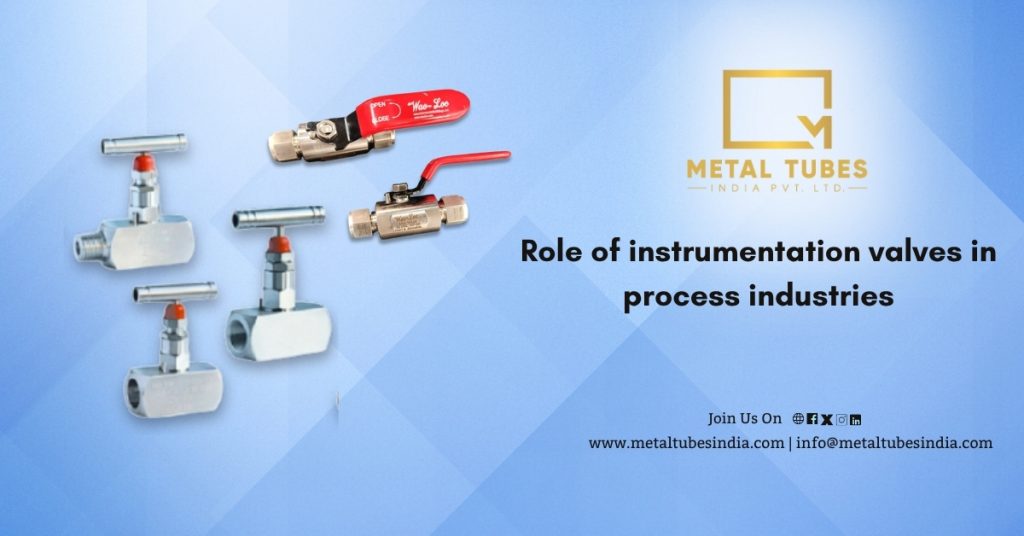
Introduction Instrumentation valves in process industries play a crucial role in ensuring safety, precision, and efficiency. These valves help control the flow, pressure, and direction of fluids in critical operations. Industries such as oil & gas, power plants, and chemical processing depend heavily on instrumentation valves. Without them, accurate measurement and safe operations would not be possible. In this blog, we explain the role of instrumentation valves in process industries, including their types, applications, and benefits. What Are Instrumentation Valves? Instrumentation valves are specialized valves used to control and isolate fluid flow in industrial systems. They are commonly installed with pressure gauges, transmitters, and analyzers. These valves are designed for: High-pressure conditions Leak-proof performance Precise flow control Because of their accuracy, instrumentation valves in process industries are essential for maintaining system stability. Why Are Instrumentation Valves Important? 1. Safety in Industrial Operations Instrumentation valves help isolate systems during maintenance or emergencies. This reduces the risk of leaks and accidents. 2. Accurate Measurement They ensure proper pressure and flow control. As a result, instruments provide correct readings. 3. Leak Prevention High-quality valves minimize leakage. This is especially important in hazardous industries. 4. Improved Efficiency Stable flow conditions improve overall plant performance and productivity. Types of Instrumentation Valves Ball Valves Ball valves provide quick shut-off and tight sealing. They are widely used in industrial systems. Needle Valves Needle valves allow precise flow control. They are ideal for instrumentation applications. Manifold Valves Manifold valves combine multiple valves into one unit. They are commonly used with pressure transmitters. Check Valves Check valves prevent reverse flow. This protects equipment from damage. Relief Valves Relief valves release excess pressure. They ensure system safety. Applications of Instrumentation Valves in Process Industries Instrumentation valves in process industries are used across multiple sectors: Oil and Gas Industry They control flow in pipelines and maintain pressure systems. Power Plants They regulate steam and water flow in boilers and turbines. Chemical Industry They handle corrosive fluids and ensure process accuracy. Pharmaceutical Industry They maintain contamination-free flow and high precision. Marine and Offshore They are used in high-pressure and corrosion-resistant environments. Key Features to Consider When selecting instrumentation valves, consider these features: Corrosion resistance High-pressure tolerance Leak-proof design Long service life Compliance with ASTM, ASME, and ISO standards Benefits of Instrumentation Valves Using high-quality instrumentation valves in process industries offers several benefits: Increased safety Reduced maintenance costs Better system accuracy Long-term durability Efficient operations Why Choose M Metal Tubes India Pvt Ltd? M Metal Tubes India Pvt Ltd is a trusted manufacturer and exporter of instrumentation valves, fittings, pipes, and tubes. We offer: High-quality products Strict quality control Global standard compliance Timely delivery Our solutions are widely used in various process industries for reliable performance. Conclusion Instrumentation valves in process industries are essential for maintaining safety, accuracy, and efficiency. They play a key role in controlling fluid systems across multiple sectors. Choosing the right valves improves performance and reduces risks. Therefore, investing in high-quality instrumentation valves is crucial for long-term success.