
Role of Instrumentation Valves in Process Industries
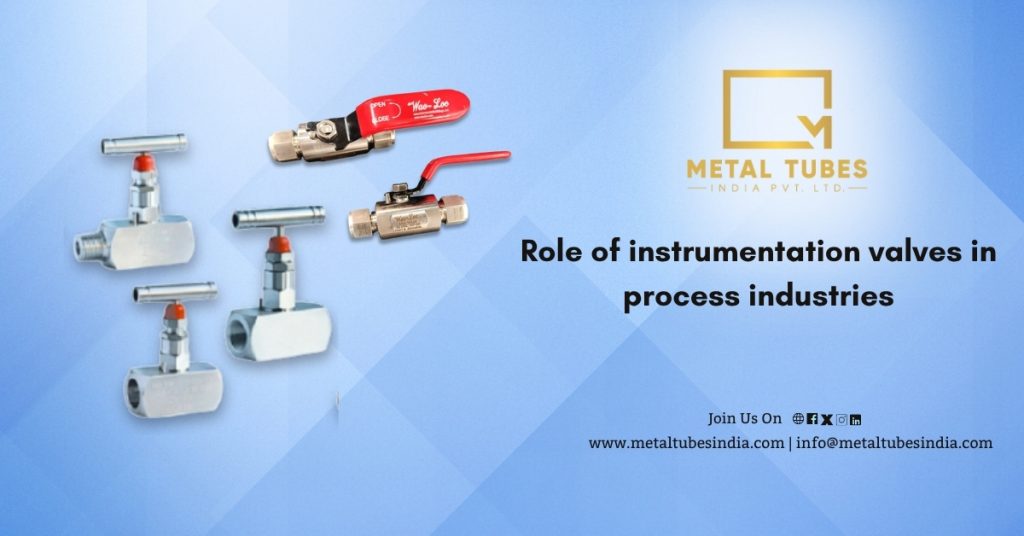
Introduction Instrumentation valves in process industries play a crucial role in ensuring safety, precision, and efficiency. These valves help control the flow, pressure, and direction of fluids in critical operations. Industries such as oil & gas, power plants, and chemical processing depend heavily on instrumentation valves. Without them, accurate measurement and safe operations would not be possible. In this blog, we explain the role of instrumentation valves in process industries, including their types, applications, and benefits. What Are Instrumentation Valves? Instrumentation valves are specialized valves used to control and isolate fluid flow in industrial systems. They are commonly installed with pressure gauges, transmitters, and analyzers. These valves are designed for: High-pressure conditions Leak-proof performance Precise flow control Because of their accuracy, instrumentation valves in process industries are essential for maintaining system stability. Why Are Instrumentation Valves Important? 1. Safety in Industrial Operations Instrumentation valves help isolate systems during maintenance or emergencies. This reduces the risk of leaks and accidents. 2. Accurate Measurement They ensure proper pressure and flow control. As a result, instruments provide correct readings. 3. Leak Prevention High-quality valves minimize leakage. This is especially important in hazardous industries. 4. Improved Efficiency Stable flow conditions improve overall plant performance and productivity. Types of Instrumentation Valves Ball Valves Ball valves provide quick shut-off and tight sealing. They are widely used in industrial systems. Needle Valves Needle valves allow precise flow control. They are ideal for instrumentation applications. Manifold Valves Manifold valves combine multiple valves into one unit. They are commonly used with pressure transmitters. Check Valves Check valves prevent reverse flow. This protects equipment from damage. Relief Valves Relief valves release excess pressure. They ensure system safety. Applications of Instrumentation Valves in Process Industries Instrumentation valves in process industries are used across multiple sectors: Oil and Gas Industry They control flow in pipelines and maintain pressure systems. Power Plants They regulate steam and water flow in boilers and turbines. Chemical Industry They handle corrosive fluids and ensure process accuracy. Pharmaceutical Industry They maintain contamination-free flow and high precision. Marine and Offshore They are used in high-pressure and corrosion-resistant environments. Key Features to Consider When selecting instrumentation valves, consider these features: Corrosion resistance High-pressure tolerance Leak-proof design Long service life Compliance with ASTM, ASME, and ISO standards Benefits of Instrumentation Valves Using high-quality instrumentation valves in process industries offers several benefits: Increased safety Reduced maintenance costs Better system accuracy Long-term durability Efficient operations Why Choose M Metal Tubes India Pvt Ltd? M Metal Tubes India Pvt Ltd is a trusted manufacturer and exporter of instrumentation valves, fittings, pipes, and tubes. We offer: High-quality products Strict quality control Global standard compliance Timely delivery Our solutions are widely used in various process industries for reliable performance. Conclusion Instrumentation valves in process industries are essential for maintaining safety, accuracy, and efficiency. They play a key role in controlling fluid systems across multiple sectors. Choosing the right valves improves performance and reduces risks. Therefore, investing in high-quality instrumentation valves is crucial for long-term success.