
What is a 3 Way Ball Valve? Working, Types & Uses Explained
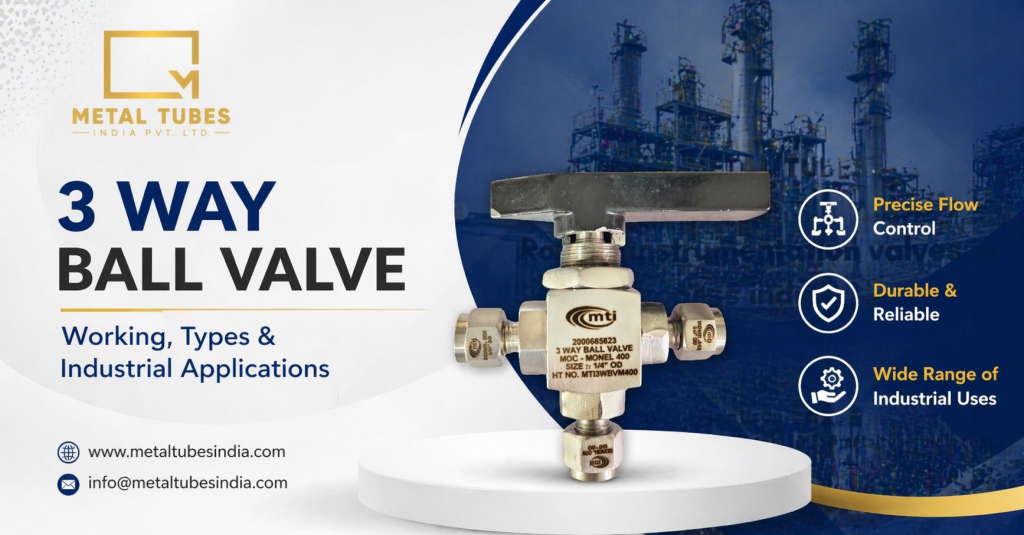
Introduction In industrial piping systems, controlling the direction and flow of fluids is essential for smooth and safe operations. While standard valves handle simple on/off control, many applications require more flexibility. This is where a 3 way ball valve becomes highly effective. Designed to manage multiple flow paths within a single unit, 3 way ball valves help reduce system complexity, improve efficiency, and minimize installation costs. They are widely used across industries such as oil & gas, chemical processing, power generation, and water treatment. In this guide, we explain what a 3 way ball valve is, how it works, its types, and its key industrial uses, so you can make an informed decision for your application. What is a 3 Way Ball Valve? A 3 way ball valve is a quarter-turn valve equipped with three ports, allowing fluid to flow in multiple directions. Unlike a standard 2-way valve, which only permits straight flow, this valve can divert, mix, or shut off flow depending on its design. The internal mechanism consists of a rotating ball with a specially designed bore. By turning the handle or actuator, the flow path changes, enabling different configurations within the same valve body. Working Principle of a 3 Way Ball Valve The working of a 3 way ball valve is based on a simple yet efficient mechanism. Inside the valve, a drilled ball rotates when the handle is turned 90 degrees. This rotation aligns the internal passage with different ports, controlling how the fluid flows. Depending on the valve design, it can: Redirect flow from one inlet to another outlet Combine flow from two sources into one line Stop flow completely when required Because of this functionality, a single 3 way ball valve can replace multiple conventional valves, making the system more compact and easier to maintain. Types of 3 Way Ball Valves 1. L-Port 3 Way Ball Valve The L-port valve has an “L”-shaped internal bore. It is mainly used for diverting flow between two outlets. Key Characteristics: Directs flow in one direction at a time Prevents mixing of fluids Suitable for switching applications 2. T-Port 3 Way Ball Valve The T-port valve features a “T”-shaped bore, allowing flow mixing or splitting. Key Characteristics: Can connect all three ports simultaneously Ideal for blending or distributing fluids Offers multiple flow configurations 3. Manual vs Actuated Valves 3 way ball valves are also classified based on operation: Manual Valves: Operated using a lever handle Actuated Valves: Controlled via pneumatic or electric actuators Actuated valves are preferred in automated systems where precision and remote control are required. Uses of 3 Way Ball Valves in Industry Oil & Gas Industry These valves are widely used for flow diversion, blending, and pipeline management in upstream and downstream operations. Chemical Processing 3 way ball valves are ideal for handling corrosive and hazardous fluids, ensuring safe and controlled mixing. Power Plants In power generation facilities, they are used in cooling systems, steam lines, and fluid distribution networks. Pharmaceutical Industry They support hygienic and precise fluid handling, which is essential for maintaining product quality. Water Treatment Plants Used for redirecting water flow and optimizing system efficiency, especially in filtration and distribution systems. Advantages of Using a 3 Way Ball Valve Combines multiple functions in one valve Reduces piping complexity and installation cost Compact and space-saving design Quick and easy operation High durability with minimal maintenance How to Choose the Right 3 Way Ball Valve Selecting the correct valve ensures long-term performance and safety. Key factors to consider include: Material: Stainless Steel (SS 304/316), Monel, Brass Pressure and Temperature Ratings Flow Requirement (L-Port or T-Port) End Connections: Threaded, flanged, or welded Automation Needs: Manual or actuated A proper selection not only improves efficiency but also reduces downtime and maintenance costs. Why Choose M Metal Tubes India Pvt Ltd? M Metal Tubes India Pvt Ltd is a trusted supplier of high-quality 3 way ball valves and instrumentation components for industrial applications. Our Strengths: Premium materials including SS 304, SS 316, and Monel 400 Strict quality inspection and testing Wide product range with customization options Competitive pricing and reliable delivery Strong presence across major industrial sectors in India We focus on delivering solutions that meet both performance and durability requirements. Conclusion A 3 way ball valve is a versatile and efficient solution for industries that require flexible flow control. With its ability to divert, mix, and regulate fluids, it simplifies piping systems while enhancing operational efficiency. Understanding its working, types, and applications will help you select the right valve for your specific needs. Looking for reliable and high-performance 3 way ball valves for your industrial projects? 👉 Contact M Metal Tubes India Pvt Ltd today for expert support and customized solutions.📩 Request a quote now and get the right valve for your application.
Instrumentation Fittings – The Backbone of Industrial Precision
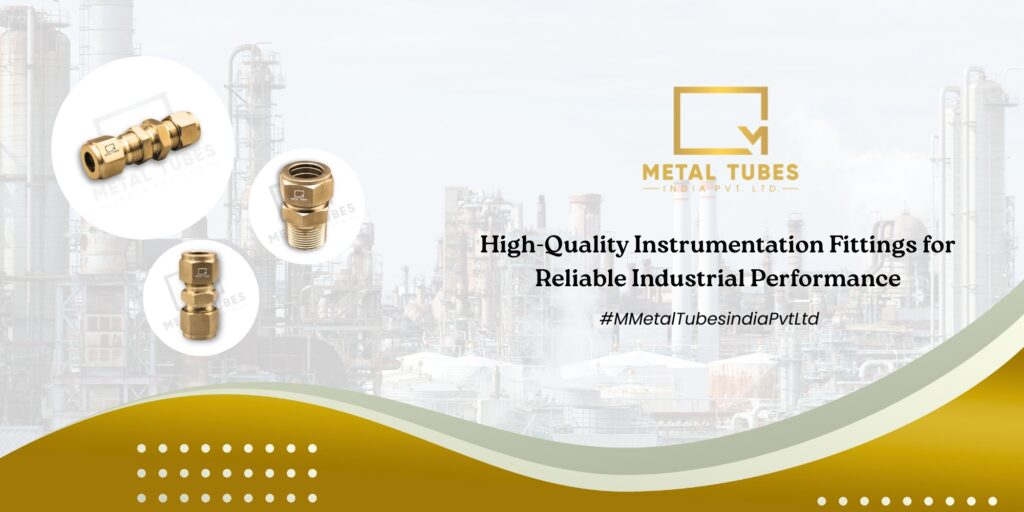
Instrumentation Fittings – The Backbone of Industrial Precision Instrumentation Fittings – The Backbone of Industrial Precision In every industrial environment, precision is critical. Even the smallest connection plays a major role in maintaining safety, accuracy, and smooth operations. One such essential component is instrumentation fittings—the backbone of reliable and efficient industrial systems. At M Metal Tubes India Pvt Ltd, we believe that every connection matters. As one of India’s trusted manufacturers and suppliers of instrumentation fittings, we deliver products engineered to withstand pressure, resist corrosion, and provide leak-free performance every time. What Are Instrumentation Fittings? Instrumentation fittings are precision-engineered connectors used to join tubes and pipes in instrumentation and control systems. They regulate and direct the flow of liquids or gases while maintaining system integrity and accuracy. These fittings work alongside critical instruments such as pressure gauges, valves, flow meters, and transmitters, making them indispensable in modern process control applications. Whether used in power plants, refineries, or marine environments, they are designed to perform reliably—even under extreme conditions. Our Range of Instrumentation Fittings At M Metal Tubes India Pvt Ltd, we manufacture a comprehensive range of instrumentation fittings to meet diverse industrial requirements. Each product is crafted with a strong focus on precision, durability, and quality. Our Product Range Includes: Compression Tube FittingsDesigned for secure, leak-proof connections in high-pressure applications. Ferrule FittingsProvide excellent tube grip and vibration resistance for long-term reliability. Flare FittingsIdeal for heavy-duty systems requiring strong mechanical sealing. Pipe FittingsManufactured for dimensional accuracy, strength, and easy installation. Male & Female ConnectorsVersatile fittings designed for extended service life across applications. All our fittings undergo strict quality checks and comply with international standards such as ASTM, DIN, and ISO. Industries We Serve Our instrumentation fittings are widely used across multiple industries, including: Oil & Gas Refineries Power Generation Plants Petrochemical & Chemical Processing Units Marine & Offshore Applications Instrumentation & Control Panels Energy and Process Industries Wherever precision, safety, and reliability are essential, M Metal Tubes India Pvt Ltd delivers dependable solutions. Why Choose M Metal Tubes India Pvt Ltd? Choosing the right instrumentation fittings is about more than just components—it’s about choosing a trusted partner. What Sets Us Apart: ✅ Superior Quality – Manufactured using premium-grade stainless steel and brass for corrosion resistance and long life✅ Precision Engineering – CNC-machined fittings with accurate dimensions and flawless finishes✅ Global Compliance – Products conform to ASTM, BS, DIN, and ISO standards✅ Timely Delivery – Efficient supply chain with ready stock for quick dispatch✅ Customer-First Approach – Built on trust, transparency, and long-term partnerships We are also proud of our in-house brand, Waoloc Instrumentation, offering high-performance valves, manifold valves, and needle valves for critical industrial applications. Our Commitment to Quality Quality is at the core of everything we do. From raw material inspection to final testing, our instrumentation fittings undergo rigorous checks for pressure resistance, dimensional accuracy, and performance. Each product is carefully packed to ensure it reaches you in perfect condition—ready to perform from day one. Sustainability & Continuous Innovation At M Metal Tubes India Pvt Ltd, we are committed to sustainable manufacturing practices. We continuously work to reduce waste, optimize energy usage, and improve product efficiency. Through ongoing research and development, we innovate smarter, stronger, and more environmentally responsible instrumentation solutions. Conclusion Instrumentation fittings may be small components, but their impact on industrial systems is significant. At M Metal Tubes India Pvt Ltd, we take pride in manufacturing fittings that represent accuracy, reliability, and long-lasting performance. Every product we deliver reflects our dedication to engineering excellence and customer satisfaction. Get in Touch With Us Looking for high-quality, reliable instrumentation fittings for your industrial needs? 📞 Contact us today!Let’s build stronger, safer, and more efficient connections together. Email: info@metaltubesindia.comPhone: +91 9323076453Website: www.metaltubesindia.com More Blogs Understanding Flange Ratings – M Metal Tubes India Pvt Ltd What Is Flange Class? Complete Guide to Class 150, 300, 600 Ratings | M Metal Tubes India Pvt Ltd Manufacturing Process of Stainless Steel Pipes Step by Step | Industrial Guide How High-Quality Tubing Improves Process Reliability | Industrial Guide 2025
Flare Fittings vs Compression Fittings | Key Differences Explained

Discover the main differences between flare fittings and compression fittings, their uses, installation benefits, and which one fits your application best. Learn more with M Metal Tubes India Pvt Ltd.