
Export-Quality M Metal Tubes India Pvt Ltd: What Global Buyers Look For
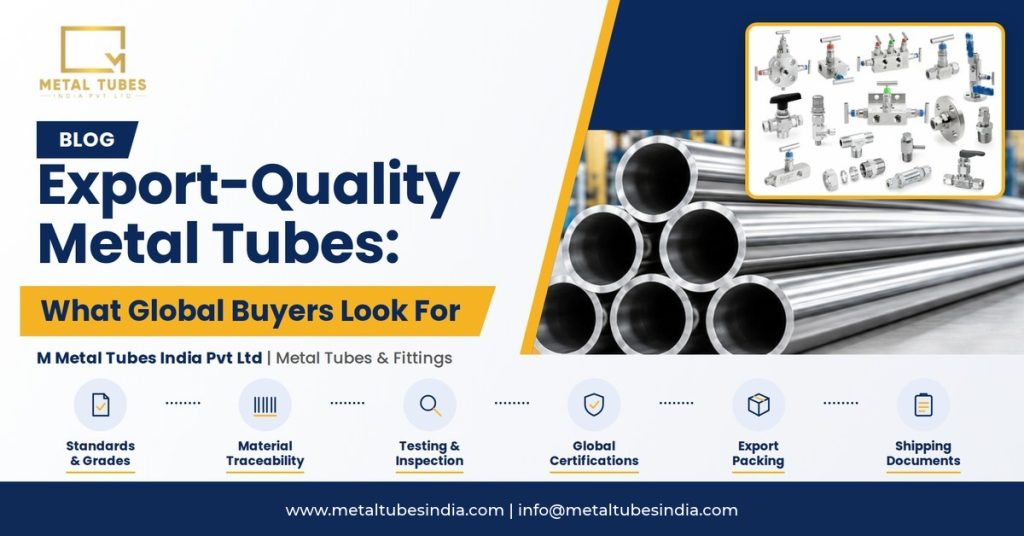
Export-quality metal tubes are tubes that meet international standards for chemistry, dimensions, strength and finish. They also come with test certificates, traceable batches and export-grade packing. Global buyers check all of these before they place an order. In this guide, M Metal Tubes India Pvt Ltd explains what overseas buyers look for and how we meet each requirement. What Makes Metal Tubes Export-Quality? A tube is not export-quality just because it looks good. It must pass checks that a buyer in Europe, the Middle East or North America can verify on paper. In short, export-quality metal tubes share five traits: They follow a recognised standard such as ASTM, ASME, EN or DIN. Their chemical and mechanical properties are tested and documented. Their dimensions stay within tight tolerances. Their surface finish is clean and consistent. They are packed to survive long sea or air freight. Miss any one of these, and a shipment can be rejected at the port. That costs time and money. 1. Compliance With International Standards Global buyers start with the standard. It tells them the tube will behave as expected in their application. Common standards for stainless steel tubes include: ASTM A269: seamless and welded austenitic tubing for general service. ASTM A213: seamless tubes for boilers, superheaters and heat exchangers. ASTM A249: welded tubes for boilers and heat exchangers. ASTM A312: pipes for high-temperature and corrosive service. EN 10216-5: seamless stainless steel tubes for pressure purposes. Check that the standard on the quote matches the standard in your purchase order. Also confirm the grade, for example SS 304, 304L, 316 or 316L. A small mismatch can change corrosion resistance and weld quality. At M Metal Tubes India Pvt Ltd, we supply tubes to all the major international standards and grades. 2. Material Quality and Traceability Buyers want to know exactly what their tubes are made of. For that reason, good suppliers offer full traceability from raw material to finished tube. Look for these documents: Mill Test Certificate (MTC): most orders ask for EN 10204 Type 3.1. Heat number tracking: each tube links back to its melt batch. Chemical analysis: it confirms nickel, chromium and molybdenum levels. Mechanical test results: these cover tensile strength, yield strength and elongation. Many buyers also request Positive Material Identification (PMI). This test uses a handheld analyser to check the alloy on the finished tube. As a result, it catches grade mix-ups before shipping. At M Metal Tubes India Pvt Ltd, every tube comes with full material traceability and test certificates. 3. Dimensional Accuracy and Tolerances Tubes must fit the equipment they go into. Therefore, buyers check outer diameter, wall thickness, length and straightness against the standard. Here is what to confirm: Outer diameter and wall thickness tolerance. Length tolerance, whether fixed or random. Ovality and straightness. Ends cut square and free of burrs. Tight tolerances matter most for heat exchangers, instrumentation lines and hydraulic systems. In these uses, a small error can cause leaks or poor heat transfer. At M Metal Tubes India Pvt Ltd, we hold tight tolerances and check dimensions on every lot. 4. Testing and Quality Control A certificate means little without real testing behind it. Reliable manufacturers test tubes during production and again before dispatch. Common tests for export-quality metal tubes include: Hydrostatic test: checks the tube holds pressure without leaking. Eddy current test: finds small surface and sub-surface flaws. Flaring and flattening tests: show how the tube behaves under deformation. Intergranular corrosion test: confirms resistance in harsh environments. Hardness test: verifies the tube meets the specified range. Visual and dimensional inspection: checks finish and size on every lot. Buyers often hire a third-party inspector. Good suppliers welcome this, because it builds trust on both sides. At M Metal Tubes India Pvt Ltd, we test tubes during production and again before dispatch. We also welcome third-party inspection. 5. Surface Finish and Cleanliness Surface finish affects both looks and performance. For example, food, dairy and pharma buyers need smooth, clean tube surfaces that resist bacteria buildup. Common finishes include: Annealed and pickled (AP): a clean matte finish for industrial use. Bright annealed (BA): a shiny, smooth finish for sanitary and instrument use. Polished: a high-grade finish for hygienic and decorative applications. Ask for the finish level in writing. Also ask how the supplier cleans and caps the tubes after production. At M Metal Tubes India Pvt Ltd, we offer all the common finishes to match your application. 6. Certifications That Build Buyer Confidence Certifications show that a manufacturer follows a controlled process. They do not replace product testing. However, they signal discipline. Global buyers often look for: ISO 9001: a quality management system. PED 2014/68/EU: needed for pressure equipment sold in the European Union. Third-party inspection approvals: for example from TUV, SGS or Bureau Veritas. Always ask to see the certificate itself. Check the issue date, scope and validity. At M Metal Tubes India Pvt Ltd, we offer all the certifications that global buyers ask for. 7. Export-Grade Packing and Marking Tubes travel thousands of kilometres before they reach the buyer. Poor packing causes dents, scratches and rust. Strong export packing usually includes: Plastic end caps on every tube. Bundles wrapped in protective film or paper. Wooden cases or steel-strapped bundles. Moisture protection for sea freight. Clear marking of grade, size, heat number, standard and batch. In addition, correct markings help customs clearance and make warehouse handling easier. At M Metal Tubes India Pvt Ltd, we pack every export order so it arrives safe and clearly marked. 8. Documentation and Shipping Support Paperwork can delay a shipment as easily as a quality problem can. Because of this, experienced exporters prepare documents carefully. Typical export documents include: Commercial invoice and packing list. Certificate of origin. Mill test certificates. Bill of lading or airway bill. Inspection reports, where required. Global buyers also value clear delivery timelines and quick replies. A supplier who answers technical questions fast is usually well organised behind the scenes. At M Metal Tubes India Pvt Ltd,