
Inside Our Manufacturing Process: How M Metal Tubes India Ensures Zero-Defect Quality
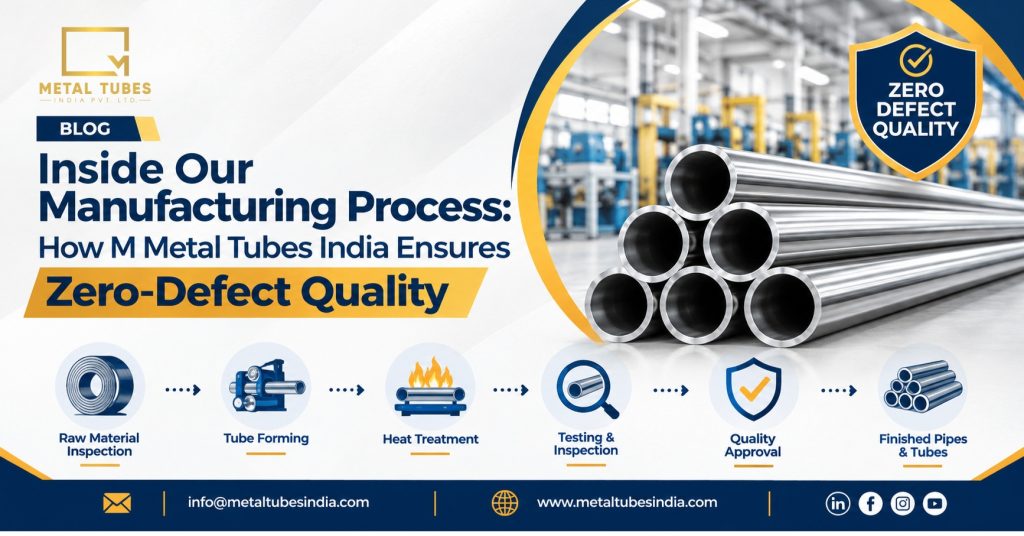
At M Metal Tubes India, our manufacturing process zero-defect quality standard shapes everything we do. First, we select the right raw material. Next, we form, treat, and test every tube with precision. As a result, our customers receive tubes they can rely on, batch after batch. In this blog, we take you inside our production floor. You’ll see exactly how we manufacture stainless steel, carbon steel, and alloy steel tubes — and why industries across oil & gas, power generation, and petrochemicals trust us with their most critical projects. Why Zero-Defect Quality Matters in Steel Tube Manufacturing A single defective tube can compromise an entire pipeline, boiler, or heat exchanger system. Therefore, our customers cannot afford to take chances with quality. For this reason, we don’t treat quality control as a final checkpoint. Instead, we build it into every stage of production. Many manufacturers call this approach “quality by design,” and it forms the foundation of our complete product range at M Metal Tubes India. Step 1: Raw Material Selection and Testing Every tube starts with the right raw material. First, our team sources billets and coils only from approved and certified suppliers. Before any material enters production, we run it through: Chemical composition testing to confirm the correct alloy grade Mechanical property verification for strength and ductility Surface inspection to rule out cracks, pits, or inclusions Consequently, if a batch doesn’t meet our internal benchmarks, we reject it immediately. This first checkpoint alone prevents a large share of potential defects before production even begins. Step 2: Precision Tube Forming Once the raw material clears inspection, it moves into forming. Depending on the specification, we use either: Seamless tube manufacturing, where we pierce and draw solid billets into hollow tubes without a weld seam Welded (ERW) tube manufacturing, where we roll and fuse steel strips using controlled high-frequency welding Our machines maintain tight tolerances on outer diameter (OD), wall thickness, and length. Because even a small deviation here can affect performance downstream, experienced operators monitor this stage closely during every shift. Step 3: Heat Treatment for Strength and Durability After forming, tubes go through heat treatment — annealing, normalizing, or quenching and tempering, depending on the grade and end application. Heat treatment achieves two important goals. First, it relieves internal stresses created during forming. Second, it enhances mechanical strength, corrosion resistance, and durability. This step becomes critical for tubes operating in high-pressure or high-temperature environments, such as our boiler and heat exchanger tubes. Step 4: Dimensional and Surface Finishing Next, every tube passes through finishing operations. This stage includes: Straightening to correct any bends from forming or heat treatment Cutting to exact length as per customer specification Surface finishing, including pickling, polishing, or bright annealing, depending on the application At this point, our quality team re-checks dimensions against the original customer specification sheet. As a result, nothing moves forward without matching the exact requirement. Step 5: Rigorous Testing Before Dispatch This is where our manufacturing process zero-defect quality commitment truly comes to life. Before we approve any tube for dispatch, we put it through a series of rigorous quality tests to check strength, pressure resistance, and any hidden surface or internal flaws. Only tubes that pass every test move to the next stage. Meanwhile, we set aside or reject anything that doesn’t meet our standard — no exceptions. Step 6: Final Inspection and Documentation Before dispatch, we run each batch of tested tubes through a final visual and dimensional inspection. In addition, we prepare complete test certificates and material traceability documentation, so customers know exactly what they’re receiving — and can trace it back to the original raw material batch if needed. This transparency explains why EPC contractors, fabricators, and industrial buyers continue to choose our seamless and welded tube solutions for repeat orders. Manufacturing Process Zero-Defect Quality: What Makes It Different Here’s what sets our process apart: Multi-stage inspection, not just a final check Experienced engineers overseeing every production stage Fully tested tubes with traceable documentation from raw material to finished product Consistent tolerances across every batch, not just samples Overall, zero-defect quality isn’t a slogan for us. Instead, it’s a system — built stage by stage, checked at every point, and backed by documentation you can trust. Frequently Asked Questions What types of steel tubes does M Metal Tubes India manufacture? We manufacture seamless and welded (ERW) tubes in stainless steel, carbon steel, and alloy steel grades. Consequently, our tubes serve industries like oil & gas, power, petrochemicals, and infrastructure. How does M Metal Tubes India ensure quality at every stage? We run quality checks at every stage of production — raw material testing, forming, heat treatment, finishing, and final testing — rather than only at the end. Are all tubes tested before dispatch? Yes. We test every tube rigorously and inspect it fully before dispatch. Therefore, only fully tested, defect-free tubes reach our customers. Conclusion From raw material to final dispatch, we design every stage of our production around one commitment: delivering manufacturing process zero-defect quality to every customer, every time. This is the standard M Metal Tubes India holds itself to — and it explains why our tubes perform reliably in the industries that can least afford failure. Looking for steel tubes manufactured to the highest quality standards? Contact M Metal Tubes India today to discuss your requirement.