
Manifold Valves Manufacturer in India: Uses, Selection Guide & Benefits
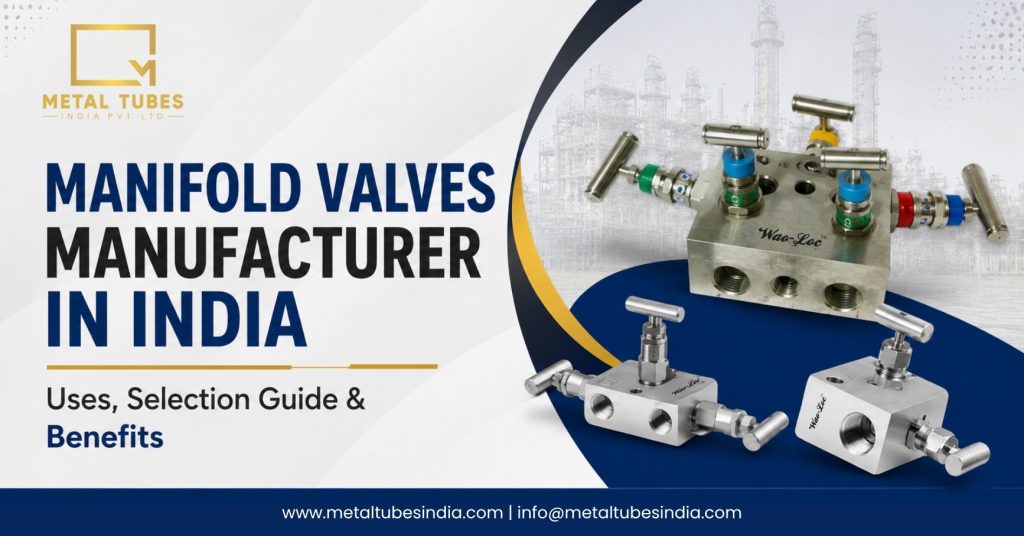
M Metal Tubes India Pvt Ltd is a leading manifold valves manufacturer in India, supplying precision instrumentation valves to industries across the country. Manifold valves protect instruments, control flow, and make maintenance safer and faster. If you are searching for a reliable manifold valves manufacturer in India, this guide covers everything you need. You will learn what manifold valves do, the types available, how to choose the right one, and why they matter for your plant. Alongside manifolds, we also manufacture needle valves, ball valves, condensate pots, and instrumentation fittings. Let’s break this down step by step. What Is a Manifold Valve? A manifold valve is a compact assembly of valves. It connects instruments, like pressure gauges or transmitters, to the main process line. In simple words, it acts as a bridge. It links your measuring instrument to the pipeline safely. At the same time, it allows easy isolation, calibration, and maintenance without shutting down the entire system. According to the International Society of Automation (ISA), correctly specified instrument isolation valves are essential for accurate process measurement and plant safety. That’s why manifold valves are widely used in oil and gas, power plants, chemical processing, and pharmaceutical industries. Why Choose a Trusted Manifold Valve Manufacturer? Manifold valves are not just connectors. They serve several important functions on the plant floor, so choosing an experienced manifold valves manufacturer in India matters. Here’s why manifold valves matter: Instrument protection – They shield delicate instruments from pressure spikes. Easy isolation – Operators can isolate instruments for maintenance without stopping the process. Leak prevention – A compact, single-block design reduces potential leak points. Space saving – One manifold replaces multiple individual valves and fittings. Improved safety – Operators can safely vent, equalize, or calibrate instruments. Because of these benefits, manifold valves have become a standard requirement across most instrumentation systems. Types of Manifold Valves We Manufacture in India Different applications need different manifold configurations. As a dedicated manifold valves manufacturer in India, we produce the following types: 1. 2-Valve Manifold This is the simplest configuration. It is mainly used with pressure transmitters. It allows isolation and venting of the process line. 2. 3-Valve Manifold This type is ideal for differential pressure (DP) transmitters. It includes two isolation valves and one equalizing valve. As a result, it allows safe zero calibration. 3. 5-Valve Manifold This is the most advanced configuration. It offers two isolation valves, two vent valves, and one equalizing valve. Consequently, it provides maximum flexibility and safety for high-pressure DP applications. Each type is available in various materials, including stainless steel and carbon steel, depending on your process requirements. You can pair these with our needle valves for finer flow control, or our ball valves for quick shut-off. Key Applications of Manifold Valves Manifold valves are used across a wide range of industries. Some common applications include: Oil and gas refineries Power generation plants Chemical and petrochemical units Pharmaceutical manufacturing Water treatment plants Marine and offshore platforms In each of these industries, manifold valves ensure accurate readings and safer instrument handling. Many of these plants also rely on our condensate pots to protect pressure instruments in steam lines. How to Select the Right Manifold Valve Choosing the correct manifold valve is essential. Otherwise, it can affect system performance and safety. Here’s a simple selection guide: Identify your instrument type – Pressure gauge, transmitter, or DP transmitter. Check the pressure rating – Match the manifold’s rating with your process line. Select the right material – Stainless steel works well for corrosive environments. Consider the connection type – NPT, BSP, or flanged, based on your piping system. Choose the valve configuration – 2-valve, 3-valve, or 5-valve, depending on your application. If you’re unsure which configuration suits your process, our engineering team at M Metal Tubes India Pvt Ltd can help you decide. Benefits of Choosing M Metal Tubes India Pvt Ltd as Your Manifold Valve Manufacturer As a trusted manifold valves manufacturer in India, we focus on quality, precision, and reliability. Here’s what sets us apart: Premium raw materials – We use high-grade stainless steel and alloy materials. Precision engineering – Every valve undergoes strict quality checks. Custom solutions – We manufacture as per your exact specifications. Wide product range – Alongside manifolds, we also supply needle valves, ball valves, condensate pots, and instrumentation fittings. Pan-India supply – We serve clients across multiple industries and states. Because of this, plants across India trust us for their instrumentation valve needs. Final Thoughts Manifold valves are essential components in any instrumentation system. They protect instruments, improve safety, and simplify maintenance. Therefore, choosing the right manifold valves manufacturer in India matters just as much as choosing the right valve type. At M Metal Tubes India Pvt Ltd, we combine engineering expertise with quality manufacturing to deliver manifold valves you can rely on. Looking for a dependable manifold valves manufacturer in India? Contact M Metal Tubes India Pvt Ltd today for a quote. Frequently Asked Questions Q1. What is the difference between a 2-valve and 5-valve manifold? A 2-valve manifold offers basic isolation and venting. A 5-valve manifold adds equalizing and dual venting, making it suitable for high-pressure DP transmitter applications. Q2. Which material is best for manifold valves? Stainless steel is the most common choice. It resists corrosion and performs well in high-pressure, high-temperature environments. Q3. Do you provide custom manifold valve solutions? Yes. As an experienced manifold valves manufacturer in India, M Metal Tubes India Pvt Ltd manufactures manifold valves as per client-specific pressure ratings, connection types, and material requirements.
Types of Male Connectors: A Complete Guide to Instrumentation Fittings
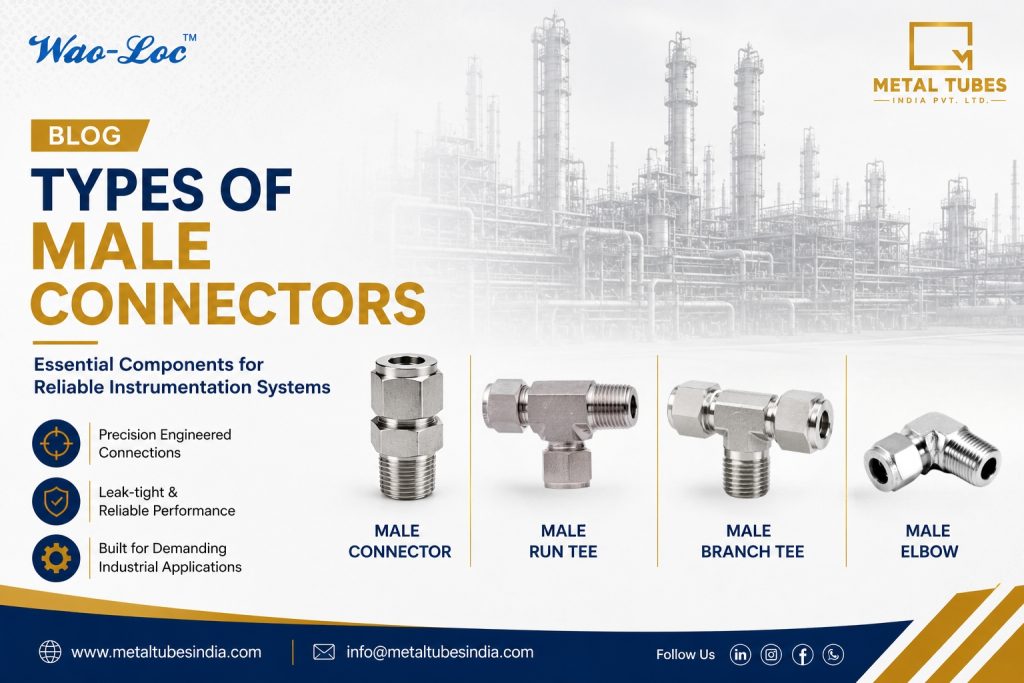
If you’re comparing the different types of male connectors for your next project, you’re in the right place. Choosing the correct connector matters it’s one of the most important decisions an engineer makes when building a leak-proof instrumentation system. So, where do you start? Male connectors form the backbone of any instrumentation tube fittings setup. They connect tubing to valves, gauges, and manifolds. And they do it with precision. At M Metal Tubes India Pvt Ltd, we manufacture a full range of stainless steel male connectors. We build them for oil & gas, petrochemical, power, pharmaceutical, and process industries. In this guide, we explain all six types of male connectors, their applications, and how to pick the right one. Whether you need instrumentation fittings male connectors, tube-to-thread adapters, or specialized bulkhead and tee connectors, this blog has you covered. What Is a Male Connector in Instrumentation Fittings? A male connector joins a tube to a female-threaded port on a valve or instrument. One end grips the tubing through a compression fitting. The other end has male threads NPT, BSP, or BSPP that screw directly into equipment. These threads follow standard pipe thread specifications set by bodies like ASME, which define dimensions and tolerances for interchangeable fittings. Male connectors matter because they: Create a leak-tight seal, even under high pressure and vibration Allow quick assembly and disassembly for maintenance Remove the need for welding in critical instrumentation lines Resist corrosion when made from stainless steel Now, let’s look at the six main types of male connectors and where you’ll use each one. The 6 Main Types of Male Connectors in Instrumentation Fittings Below, we break down each of the six types of male connectors you’ll find in a typical instrumentation fittings catalog. 1. Male Connector (Tube OD x Male NPT) Engineers use the Male Connector (Tube OD x Male NPT) more than any other fitting in instrumentation tube fittings. One end connects to the tube’s outer diameter through a compression ferrule. The other end carries National Pipe Thread (NPT), which screws into instruments, valves, or manifolds. Key applications: Connecting instrumentation tubing to pressure gauges Joining tubing to valve bodies in process skids Serving oil & gas and chemical plants worldwide We offer this fitting in multiple tube OD sizes — 1/4″, 3/8″, 1/2″, and more. We also match it to various NPT thread sizes so it fits international piping standards. 2. Male Connector (BSP/BSPP) Some regions follow British Standard Pipe threads instead of NPT. That’s where the Male Connector (BSP/BSPP) comes in. BSP (tapered) and BSPP (parallel) threads dominate European and Middle Eastern instrumentation systems. Key applications: Export projects that require BSP-standard fittings Instrumentation systems built to DIN/ISO standards Setups where an O-ring seal (BSPP) gives a more reliable connection Not sure which thread type you need? Your plant’s regional piping code decides it. Our engineering team can help you choose correctly. 3. Male Elbow 90 Degree Space is often tight in a control panel. That’s exactly where the Male Elbow 90 Degree connector helps. It lets tubing change direction by 90 degrees while connecting to a threaded port — no extra bending required. Key applications: Panel-mounted instrumentation in tight spaces Reducing tube bends, which lowers stress on the tubing Connecting tubing to instruments mounted at right angles As a result, using a male elbow 90 degree connector saves installation time. It also improves the overall strength of the tube run. 4. Male Bulkhead Connector Need to pass tubing through a wall or panel? Use a Male Bulkhead Connector. It maintains a leak-proof seal on both sides, thanks to a locknut and a threaded body that passes through a drilled hole. Key applications: Panel mounting in control cabinets and instrument enclosures Passing tubing through pressure vessel walls Vibration-resistant connections in demanding environments In fact, this is one of the most requested instrumentation fittings male connector types among OEMs who build compact instrumentation panels. 5. Male Run Tee The Male Run Tee connector has three ports. Two tube-end ports sit in a straight line the “run.” The third port carries a male thread for a branch connection. This design lets a straight tube run continue without interruption, while still offering a threaded point for a gauge or transmitter. Key applications: Installing pressure gauges mid-line, without breaking the tube run Adding branch connections for instrumentation sensors Cutting down the number of fittings in complex tube layouts 6. Male Branch Tee The Male Branch Tee looks similar to the run tee. However, the male-threaded port sits differently. It typically creates a perpendicular connection, while the tube run stays on the same centerline. Use it when you need the threaded port to sit off to the side, not in line with the main run. Key applications: Multi-point instrumentation sampling systems Adding a threaded takeoff point in compact panel layouts Creating a perpendicular branch off a continuous tube line Male Run Tee vs Male Branch Tee What’s the Difference? Port orientation makes the difference. A run tee keeps the branch port in line with the flow path. This makes mid-line instrument installation easy. A branch tee, on the other hand, offsets the threaded port. So, it gives installers more flexibility in tight panel layouts. Why Choose Stainless Steel Male Connectors? We manufacture most instrumentation fittings including all six connector types above in stainless steel (SS 316/316L, SS 304). Why? Because instrumentation systems face tough operating conditions. Stainless steel male connectors deliver: Corrosion resistance in chemical, marine, and offshore environments High pressure and temperature tolerance for critical process lines Long service life with minimal maintenance Compliance with international instrumentation standards So, if you’re sourcing instrumentation fittings for a critical application, stainless steel is almost always the smart choice. How to Choose the Right Type Among the Different Male Connectors Before you order instrumentation fittings male connectors, check these five points: Tube size and thread size — Match the tube OD and thread type (NPT, BSP, or BSPP) to your existing system. Application layout — Choose elbows
SS304 vs SS316 Instrumentation Fittings: Complete Comparison Guide for Industrial Applications
The SS304 vs SS316 Instrumentation Fittings comparison is one of the most important considerations when selecting components for industrial instrumentation systems. Both stainless steel grades offer excellent durability and reliability. However, they differ in corrosion resistance, chemical composition, cost, and applications. Understanding the differences between SS304 and SS316 instrumentation fittings can help engineers, procurement teams, and plant operators choose the right material for long-term performance. In this guide, we will compare SS304 vs SS316 instrumentation fittings in terms of corrosion resistance, strength, durability, temperature performance, cost, and industrial applications. Moreover, we will explain when to choose SS304 and when SS316 becomes the better investment. By the end of this article, you will have a clear understanding of which material best suits your operational requirements. What Are Instrumentation Fittings? Instrumentation fittings are precision-engineered components used to connect, control, and direct the flow of liquids and gases within instrumentation systems. These fittings play a critical role in maintaining leak-free performance, ensuring system reliability, and supporting safe operations. Common types of instrumentation fittings include: Tube Fittings Double Ferrule Fittings Compression Fittings Elbows Tees Unions Reducers Adapters As a result, these fittings are widely used in oil and gas, petrochemical, chemical processing, pharmaceutical, and power generation industries. Understanding Stainless Steel Grades Before comparing SS304 and SS316 instrumentation fittings, it is important to understand the role of stainless steel in industrial systems. Stainless steel contains chromium, which forms a protective oxide layer on the surface. Consequently, this layer helps prevent rust and corrosion. Furthermore, additional alloying elements can improve performance in challenging environments. The two most popular grades for instrumentation fittings are SS304 and SS316. Although they appear similar, their performance differs significantly under certain operating conditions. What Is SS304 Stainless Steel? SS304 is an austenitic stainless steel that contains approximately 18–20% chromium and 8–10.5% nickel. Because of its balanced properties and cost-effectiveness, it has become one of the most widely used stainless steel grades worldwide. Benefits of SS304 Instrumentation Fittings Excellent corrosion resistance in normal environments Good mechanical strength Easy fabrication and welding Cost-effective solution Widely available in global markets Therefore, SS304 instrumentation fittings are suitable for many general industrial applications. What Is SS316 Stainless Steel? SS316 is an upgraded stainless steel grade that contains molybdenum in addition to chromium and nickel. The presence of molybdenum significantly improves corrosion resistance, especially in chloride-rich and chemically aggressive environments. Benefits of SS316 Instrumentation Fittings Superior resistance to corrosion Better protection against chlorides Longer service life Excellent performance in marine applications Enhanced resistance to chemicals and acids Consequently, SS316 instrumentation fittings are often selected for demanding industrial environments. SS304 vs SS316 Instrumentation Fittings: Key Differences 1. Chemical Composition The primary difference between SS304 and SS316 instrumentation fittings is the addition of molybdenum in SS316. Property SS304 SS316 Chromium 18–20% 16–18% Nickel 8–10.5% 10–14% Molybdenum No 2–3% As a result, SS316 offers better protection against corrosion and pitting. 2. Corrosion Resistance Corrosion resistance is often the deciding factor when selecting instrumentation fittings. SS304 performs well in freshwater and general industrial environments. However, it may experience pitting corrosion when exposed to chlorides or saltwater. On the other hand, SS316 performs exceptionally well in coastal, marine, and chemical processing environments. Therefore, industries that face harsh conditions often prefer SS316. 3. Mechanical Strength Both materials provide excellent strength and durability. In most industrial applications, the difference in mechanical performance is minimal. Nevertheless, SS316 generally offers slightly better performance under aggressive operating conditions. 4. Temperature Performance Instrumentation systems frequently operate at elevated temperatures. While both grades perform well, SS316 offers improved resistance in high-temperature environments. Therefore, SS316 is often selected for applications involving extreme process conditions. 5. Cost Comparison Cost is another important factor when comparing SS304 vs SS316 instrumentation fittings. SS304 is more affordable because it contains lower levels of alloying elements. Consequently, it is commonly used in projects where budget is a major consideration. However, SS316 often delivers greater long-term value due to reduced maintenance costs and longer service life. Applications of SS304 Instrumentation Fittings SS304 instrumentation fittings are commonly used in: Food processing plants Water treatment facilities HVAC systems Pharmaceutical equipment General manufacturing industries Because these environments are relatively less corrosive, SS304 often provides sufficient performance. Applications of SS316 Instrumentation Fittings SS316 instrumentation fittings are commonly used in: Offshore oil and gas platforms Marine industries Petrochemical plants Chemical processing facilities Desalination plants Fertilizer industries Since these environments are highly corrosive, SS316 provides superior reliability and durability. How to Choose Between SS304 and SS316 Instrumentation Fittings Choose SS304 if: Your environment has low corrosion risk. Budget optimization is important. Freshwater applications are involved. General industrial performance is sufficient. Choose SS316 if: Chlorides are present. The installation is near coastal areas. Chemical exposure is significant. Maximum service life is required. Downtime must be minimized. Therefore, the final decision should be based on operating conditions rather than initial cost alone. Frequently Asked Questions Is SS316 better than SS304? SS316 offers better corrosion resistance. However, SS304 may be the better choice for standard industrial applications due to its lower cost. Why is SS316 more expensive? SS316 contains molybdenum and higher nickel content. Consequently, its production cost is higher than SS304. Can SS304 be used in marine environments? While SS304 can be used in some marine applications, SS316 is generally recommended because of its superior resistance to saltwater corrosion. Which stainless steel grade lasts longer? In corrosive environments, SS316 typically lasts longer and requires less maintenance. Conclusion When comparing SS304 vs SS316 instrumentation fittings, there is no universal winner. Instead, the best choice depends on your operating environment, process requirements, and budget. If you need a cost-effective solution for general industrial applications, SS304 instrumentation fittings are an excellent option. However, if your system operates in marine, chemical, offshore, or highly corrosive environments, SS316 instrumentation fittings provide greater protection, longer service life, and improved reliability. Ultimately, selecting the right material helps ensure leak-free performance, enhanced safety, and lower maintenance costs throughout the life of the instrumentation system.