
What Is Flange Class? Complete Guide to Class 150, 300, 600 Ratings | M Metal Tubes India Pvt Ltd
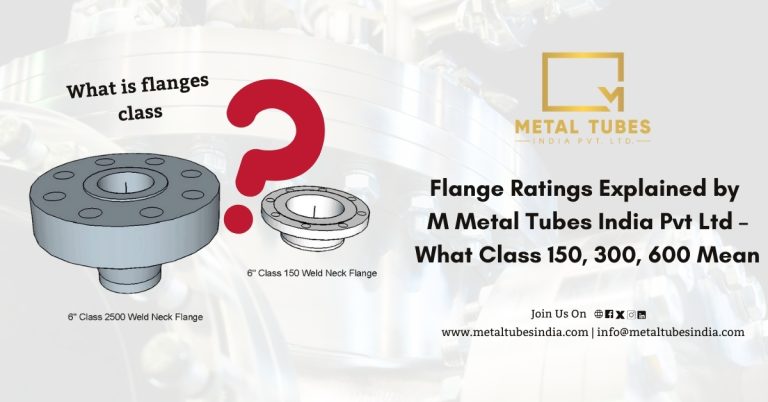
Understanding Flange Ratings: What Do Class 150, 300, and 600 Really Mean?
Guide by M Metal Tubes India Pvt Ltd
In industrial piping systems, selecting the correct flange rating is critical for ensuring safety, reliability, and long-term performance. Flange ratings directly affect how well a system handles pressure, temperature, and operating stress.
At M Metal Tubes India Pvt Ltd, we support industries such as oil & gas, petrochemical, power generation, marine, HVAC, and instrumentation by supplying flanges that meet the right pressure and temperature requirements.
Terms like Class 150, Class 300, and Class 600 appear frequently in piping drawings, specifications, and RFQs. But what do these numbers actually mean?
This guide explains flange ratings in a simple, practical, and easy-to-understand way.
1. What Is a Flange Rating?
A flange rating indicates the maximum pressure and temperature a flange can safely withstand, as defined by ASME standards.
Flange ratings are determined by several factors, including:
Flange thickness
Bolt size and bolt circle
Material grade
Operating temperature
Pressure load capacity
In simple terms:
👉 Higher flange class = higher pressure and temperature handling capability
2. Common Flange Classes We Supply
At M Metal Tubes India Pvt Ltd, we manufacture and supply flanges as per ASME B16.5 standards in the following pressure classes:
Class 150
Class 300
Class 400
Class 600
Class 900
Class 1500
Class 2500
Among these, Class 150, Class 300, and Class 600 are the most widely used across industrial applications.
3. Class 150 vs Class 300 vs Class 600 – Key Differences
Below is a practical comparison to help you understand where each flange class is typically used.
Class 150 Flanges – Low Pressure Applications
Common applications include:
Water pipelines
General utility piping
HVAC systems
Low-pressure steam lines
Standard fluid transfer systems
Why choose Class 150?
It is cost-effective, reliable, and suitable for non-critical services.
Approximate pressure capacity:
✔ Around 19–20 bar, depending on material and temperature.
Class 300 Flanges – Medium Pressure Applications
Commonly used in:
Oil and gas pipelines
Chemical processing lines
Hot water and thermal systems
Industrial manufacturing plants
Why industries prefer Class 300:
It offers nearly double the pressure capacity of Class 150, making it ideal for moderate pressure and temperature conditions.
Approximate pressure capacity:
✔ Around 50+ bar, depending on material and operating temperature.
Class 600 Flanges – High Pressure & High Temperature Applications
Typically used in:
High-pressure steam pipelines
Oil & gas processing systems
Marine and offshore installations
Power generation plants
Refineries and chemical plants
Why Class 600 is selected:
It features a thicker, heavier design that provides maximum safety in critical operating conditions.
Approximate pressure capacity:
✔ 100+ bar, depending on material and temperature.
4. How Temperature Affects Flange Ratings
Flanges can handle higher pressure at lower temperatures.
As temperature increases, material strength decreases, which reduces pressure capacity.
For example:
A Class 300 SS316 flange will have a lower pressure rating at 400°C than it does at 100°C.
At M Metal Tubes India Pvt Ltd, we always follow ASME pressure–temperature charts before recommending a flange class.
5. Higher Flange Class Means Heavier Construction
As flange class increases:
Flange thickness increases
Bolt circle diameter becomes larger
Overall weight increases
This added mass and strength ensure safe and leak-free operation under higher loads.
6. Material Selection Plays a Major Role
We manufacture and supply flanges in:
Stainless Steel (SS304, SS316, SS316L)
Carbon Steel (A105, A350 LF2)
Duplex and Super Duplex Steel
Alloy Steel
Each material behaves differently under pressure and temperature.
For example, a Class 300 carbon steel flange performs differently than a Class 300 stainless steel flange at elevated temperatures.
👉 Flange class and material must always be considered together.
7. How to Choose the Right Flange Rating
Use this simple selection guide:
✔ Choose Class 150 if:
Operating pressure is low
Temperature is moderate
Application is non-critical
✔ Choose Class 300 if:
Pressure is medium
The pipeline carries chemicals or process fluids
Operating temperatures are higher
✔ Choose Class 600 if:
The system is safety-critical
High pressure or high temperature is involved
A higher safety margin is required
8. Final Summary
To summarize:
Class 150 → Low-pressure, general-purpose applications
Class 300 → Medium-pressure industrial systems
Class 600 → High-pressure, high-temperature, critical services
Flange ratings define how much pressure and temperature a flange can safely withstand as per ASME standards.
Selecting the correct flange class ensures:
✔ Safe operation
✔ Leak prevention
✔ Long service life
✔ Compliance with engineering standards
At M Metal Tubes India Pvt Ltd, we help customers select the right flange rating and material based on application and operating conditions—ensuring safe, efficient, and reliable pipeline performance.