
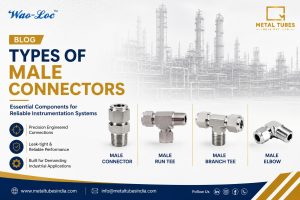
If you’re comparing the different types of male connectors for your next project, you’re in the right place. Choosing the correct connector matters it’s one of the most important decisions an engineer makes when building a leak-proof instrumentation system. So, where do you start?
Male connectors form the backbone of any instrumentation tube fittings setup. They connect tubing to valves, gauges, and manifolds. And they do it with precision.
At M Metal Tubes India Pvt Ltd, we manufacture a full range of stainless steel male connectors. We build them for oil & gas, petrochemical, power, pharmaceutical, and process industries. In this guide, we explain all six types of male connectors, their applications, and how to pick the right one.
Whether you need instrumentation fittings male connectors, tube-to-thread adapters, or specialized bulkhead and tee connectors, this blog has you covered.
What Is a Male Connector in Instrumentation Fittings?
A male connector joins a tube to a female-threaded port on a valve or instrument. One end grips the tubing through a compression fitting. The other end has male threads NPT, BSP, or BSPP that screw directly into equipment. These threads follow standard pipe thread specifications set by bodies like ASME, which define dimensions and tolerances for interchangeable fittings.
Male connectors matter because they:
- Create a leak-tight seal, even under high pressure and vibration
- Allow quick assembly and disassembly for maintenance
- Remove the need for welding in critical instrumentation lines
- Resist corrosion when made from stainless steel
Now, let’s look at the six main types of male connectors and where you’ll use each one.
The 6 Main Types of Male Connectors in Instrumentation Fittings
Below, we break down each of the six types of male connectors you’ll find in a typical instrumentation fittings catalog.
1. Male Connector (Tube OD x Male NPT)
Engineers use the Male Connector (Tube OD x Male NPT) more than any other fitting in instrumentation tube fittings. One end connects to the tube’s outer diameter through a compression ferrule. The other end carries National Pipe Thread (NPT), which screws into instruments, valves, or manifolds.
Key applications:
- Connecting instrumentation tubing to pressure gauges
- Joining tubing to valve bodies in process skids
- Serving oil & gas and chemical plants worldwide
We offer this fitting in multiple tube OD sizes — 1/4″, 3/8″, 1/2″, and more. We also match it to various NPT thread sizes so it fits international piping standards.
2. Male Connector (BSP/BSPP)
Some regions follow British Standard Pipe threads instead of NPT. That’s where the Male Connector (BSP/BSPP) comes in. BSP (tapered) and BSPP (parallel) threads dominate European and Middle Eastern instrumentation systems.
Key applications:
- Export projects that require BSP-standard fittings
- Instrumentation systems built to DIN/ISO standards
- Setups where an O-ring seal (BSPP) gives a more reliable connection
Not sure which thread type you need? Your plant’s regional piping code decides it. Our engineering team can help you choose correctly.
3. Male Elbow 90 Degree
Space is often tight in a control panel. That’s exactly where the Male Elbow 90 Degree connector helps. It lets tubing change direction by 90 degrees while connecting to a threaded port — no extra bending required.
Key applications:
- Panel-mounted instrumentation in tight spaces
- Reducing tube bends, which lowers stress on the tubing
- Connecting tubing to instruments mounted at right angles
As a result, using a male elbow 90 degree connector saves installation time. It also improves the overall strength of the tube run.
4. Male Bulkhead Connector
Need to pass tubing through a wall or panel? Use a Male Bulkhead Connector. It maintains a leak-proof seal on both sides, thanks to a locknut and a threaded body that passes through a drilled hole.
Key applications:
- Panel mounting in control cabinets and instrument enclosures
- Passing tubing through pressure vessel walls
- Vibration-resistant connections in demanding environments
In fact, this is one of the most requested instrumentation fittings male connector types among OEMs who build compact instrumentation panels.
5. Male Run Tee
The Male Run Tee connector has three ports. Two tube-end ports sit in a straight line the “run.” The third port carries a male thread for a branch connection. This design lets a straight tube run continue without interruption, while still offering a threaded point for a gauge or transmitter.
Key applications:
- Installing pressure gauges mid-line, without breaking the tube run
- Adding branch connections for instrumentation sensors
- Cutting down the number of fittings in complex tube layouts
6. Male Branch Tee
The Male Branch Tee looks similar to the run tee. However, the male-threaded port sits differently. It typically creates a perpendicular connection, while the tube run stays on the same centerline. Use it when you need the threaded port to sit off to the side, not in line with the main run.
Key applications:
- Multi-point instrumentation sampling systems
- Adding a threaded takeoff point in compact panel layouts
- Creating a perpendicular branch off a continuous tube line
Male Run Tee vs Male Branch Tee What’s the Difference? Port orientation makes the difference. A run tee keeps the branch port in line with the flow path. This makes mid-line instrument installation easy. A branch tee, on the other hand, offsets the threaded port. So, it gives installers more flexibility in tight panel layouts.
Why Choose Stainless Steel Male Connectors?
We manufacture most instrumentation fittings including all six connector types above in stainless steel (SS 316/316L, SS 304). Why? Because instrumentation systems face tough operating conditions. Stainless steel male connectors deliver:
- Corrosion resistance in chemical, marine, and offshore environments
- High pressure and temperature tolerance for critical process lines
- Long service life with minimal maintenance
- Compliance with international instrumentation standards
So, if you’re sourcing instrumentation fittings for a critical application, stainless steel is almost always the smart choice.
How to Choose the Right Type Among the Different Male Connectors
Before you order instrumentation fittings male connectors, check these five points:
- Tube size and thread size — Match the tube OD and thread type (NPT, BSP, or BSPP) to your existing system.
- Application layout — Choose elbows for direction changes, tees for branch connections, and bulkheads for panel passages.
- Pressure and temperature rating — Confirm the connector rating fits your process conditions.
- Material grade — Pick SS 316 for corrosive or offshore environments; SS 304 works for standard industrial use.
- Standards compliance — Make sure the fittings meet the certifications required in your region.
Why Choose M Metal Tubes India Pvt Ltd
We’re a trusted instrumentation fittings manufacturer, and we supply the complete range of male connectors — from Tube OD x NPT and BSP/BSPP connectors to elbows, bulkhead connectors, run tees, and branch tees. We manufacture every fitting in stainless steel and test each one for leak-proof performance under real industrial conditions.
We serve clients across oil & gas, petrochemical, power generation, and process industries. They trust us for reliable instrumentation fittings, and we make sure they can count on that reliability every time. Browse our full stainless steel male connector range or contact our team for a quote.
Frequently Asked Questions (FAQ)
Q1. What is the difference between NPT and BSP male connectors? NPT (National Pipe Thread) uses a tapered thread, common in the US. BSP (British Standard Pipe) is used across Europe, the Middle East, and Asia. These standards aren’t interchangeable, so always confirm which one your equipment needs.
Q2. What material works best for instrumentation male connectors? Most engineers choose stainless steel (SS 316/316L). It resists corrosion and holds up under high pressure and temperature.
Q3. Can you reuse male connectors after disassembly? Yes, in most cases. Compression-style male connectors allow reassembly. However, always inspect the ferrules and threads for wear first, so you maintain a leak-proof seal.
Q4. What does a bulkhead male connector do? It lets tubing pass through a panel or enclosure wall. At the same time, it keeps a sealed connection on both sides.
Q5. Where can you buy stainless steel male connectors in India? M Metal Tubes India Pvt Ltd manufactures and supplies a full range of stainless steel male connectors and instrumentation fittings across India and for export.
Conclusion
Now you know all six types of male connectors Tube OD x Male NPT, BSP/BSPP, elbow, bulkhead, run tee, and branch tee. Each one solves a specific problem in your instrumentation system. So, when you choose the right connector, you get leak-proof performance and long-term reliability.
Need high-quality stainless steel male connectors? Contact M Metal Tubes India Pvt Ltd today. Our team will help you find the right fitting for your application.